The user journey is a strategic tool that helps visualize all interactions between people and digital products over time. More than just observing the use of a feature, it allows us to understand how each stage of the experience unfolds, from the first contact with the solution to the completion of an action or goal.
Throughout this journey, users go through different moments of interaction with the product, known as touchpoints. These interactions can happen across different channels and contexts, directly influencing the perception of the experience.
For teams that develop digital products, understanding these stages is essential. When the user journey is well analyzed, it becomes possible to identify difficulties in the experience, improve interaction flows, and guide product decisions in a more strategic way.
In addition, this understanding opens space to identify opportunities for improvement and innovation. By adjusting friction points and continuously evolving the experience, companies can create more efficient solutions aligned with users' real needs.
That is why understanding the user journey becomes an important element for anyone seeking to develop more consistent and competitive digital products.
What is the user journey?
The user journey is the representation of the path a person takes when interacting with a product, service, or digital platform to achieve a specific goal.
In general, the user journey describes all stages of the experience, from the first contact with the solution to the completion of an action, such as using a feature, contracting a service, or finishing a purchase.
Also, in the UX (User Experience) context, the user journey helps product, design, and technology teams better understand people's behavior. In this way, it becomes possible to identify difficulties, improve interactions, and create more efficient experiences.
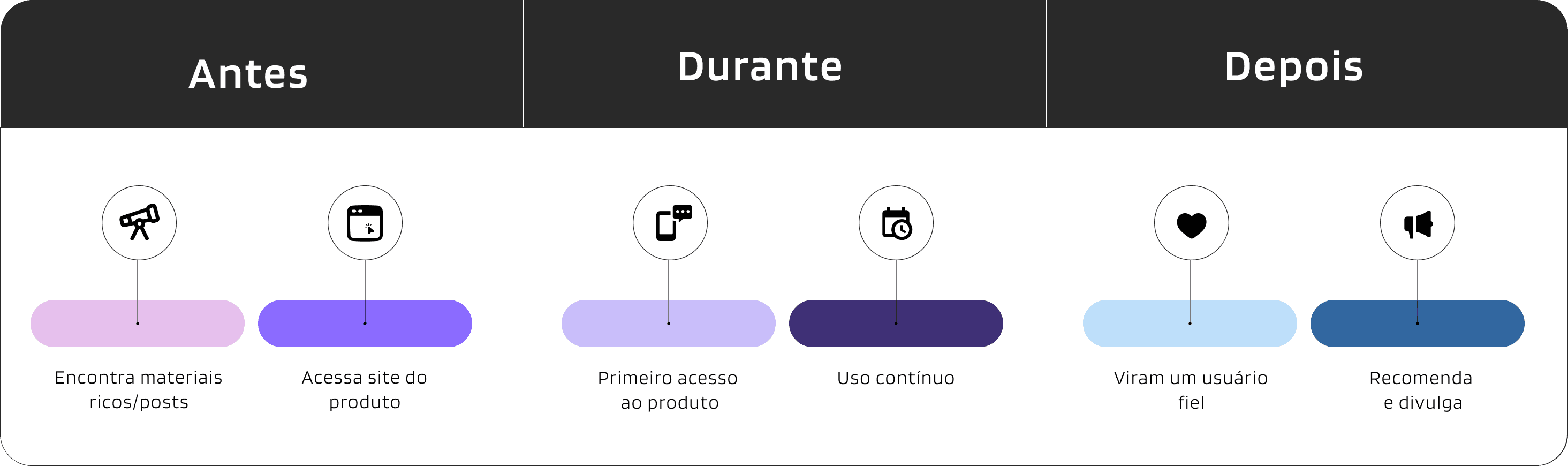
What is the user journey for?
The user journey is used to understand how people interact with a product or service over time.
In this sense, by mapping this journey, teams can visualize the entire user experience and identify points for improvement. In addition, mapping helps align product and design decisions with users' real needs.
The main objectives of the user journey include:
understanding user behavior
identifying friction points in the experience
improving interaction flows in digital products
guiding design and product decisions
creating more efficient, user-centered solutions
That is why the user journey is a tool widely used in the development of digital products and systems.
Main stages of the user journey
The user journey can vary depending on the product or service context. However, in general, it is usually divided into some main stages.
Discovery
In the discovery phase of the user journey, the person realizes they have a need or problem. From that moment on, they begin to seek information or possible solutions.
Consideration
Next, in the consideration stage, the user evaluates different available alternatives. At this point, they compare options and analyze which solution may best meet their needs.
Decision
After that, comes the decision phase. In this stage of the user journey, the person chooses a solution and takes an action, such as using a product or contracting a service.
Use or experience
After the decision, the user starts interacting with the solution. During this phase, they assess whether the product actually solves the initial problem.
Retention
Finally, when the experience is positive, the user tends to keep using the product. In addition, there is a greater likelihood of recommending it to others.
What is the main objective of the decision stage in the user journey?
In the user journey, the decision stage represents the moment when the person chooses which solution they will use to solve their problem or meet a specific need.
After going through the discovery and consideration stages, the user already has a greater understanding of the available options. In this sense, the decision stage works as the point where all the previously evaluated information is compared and turned into a concrete choice.
The main objective of this stage of the user journey is therefore to reduce doubts and make decision-making easier. For this to happen, it is essential that the user finds clear information, can quickly understand the value of the solution, and feels confident in moving on to the next action.
Several factors directly influence this moment. Among them, the following stand out:
clarity in presenting the value proposition
ease of navigation and interface use
transparency in information about the product or service
trust conveyed by the brand
social proof, such as reviews and testimonials from other users
In addition, the experience offered at this stage needs to be simple and objective. When the user encounters obstacles, excess information, or complex processes, there is a high chance of abandonment before the action is completed.
On the other hand, when the user journey is well structured and decision-oriented, the process becomes more natural. In this way, the user can move forward with confidence, clearly understanding the benefit of the solution presented.
As a result, a good experience at this stage of the user journey not only makes the choice easier, but also significantly increases conversion chances, whether in contracting a service, purchasing a product, or starting to use a digital platform.
How to create a user journey?
Creating a user journey involves mapping all the interactions a person has with a product or service over time.
In general, this process usually follows some stages:
Define the user persona or profile
Identify the user's goal
Map the touchpoints with the product
Describe the actions performed at each stage
Identify difficulties and improvement opportunities
In this way, mapping the user journey makes it possible to visualize the entire experience and guide more strategic decisions in product development.
Practical tips for building an effective user journey
Creating an efficient user journey requires more than mapping stages in a flow. It is necessary to observe how people actually use the product and adjust the experience based on data and real behavior.
Below are some practices that help product and development teams continuously evolve the user journey.
1. Observe how users use the product
An important way to improve the user journey is to follow how people use the product in their daily lives. Often, usage difficulties only appear when the system is used in real situations.
By observing this behavior, the team can identify confusing stages, less intuitive flows, or features that are not being used as expected.
In practice, teams usually:
monitor system usage sessions
analyze navigation recordings
carry out tests with real users
identify drop-off points in important flows
This information helps adjust the experience and make the journey clearer.
2. Continuously listen to what users have to say
Another fundamental practice for evolving the user journey is to maintain a constant channel of listening with users.
When the team directly understands people's difficulties and needs, it becomes easier to prioritize improvements that truly impact the experience.
In practice, this may involve:
interviews with product users
analysis of support requests
quick surveys within the platform
tracking usage metrics
Thus, decisions about improvements are no longer based on assumptions and start to consider the user's real behavior.
3. Validate flows before developing features
Before implementing new features, it is important to test how they will impact the user journey. In this sense, prototypes help visualize the experience and identify possible problems before development.
In practice, product teams usually:
create wireframes or interactive prototypes
test navigation flows with users
adjust the experience before implementation
This process reduces rework and helps ensure that the features make sense within the journey.
4. Structure the user interaction points well
Throughout the user journey, there are several moments of interaction with the product or the brand. These moments need to be organized in a clear and consistent way.
When each touchpoint is thought through strategically, the experience becomes smoother and easier to understand.
In practice, this involves:
better organizing flows within the product
ensuring consistency between screens and features
guiding the user through more complex processes
reducing unnecessary steps within the system
In this way, the journey becomes simpler and more efficient.
5. Ensure consistency across different channels
Today, many digital experiences happen across different channels. A user may start an action on the website, continue in the app, or contact support.
That is why maintaining consistency across these environments is essential to avoid friction in the user journey.
In practice, this means:
maintaining similar interface standards
ensuring continuity across different devices
aligning information between channels and systems
When this happens, the user can move forward in the journey without having to relearn how to use the product.
6. Test and continuously evolve the experience
The user journey should not be treated as something static. As the product evolves, new needs arise and the experience needs to be adjusted.
That is why many teams use experiments to evaluate improvements.
In practice, this may include:
A/B tests on features
experiments with different navigation flows
comparison of results between product versions
Thus, improvements are implemented based on data and real user behavior.
Tips for creating an effective user journey
To build a user journey that is truly useful, some best practices can help.
First, it is important to base the mapping on real data and user research. In addition, the process should consider not only actions, but also emotions and expectations throughout the experience.
Other best practices include:
map all touchpoints with the product
identify difficulties at each stage
involve different team areas in the process
review the journey as the product evolves
Thus, the user journey becomes a strategic tool for improving digital products.
User journey in UX
In the UX (User Experience) context, the user journey is one of the main tools used to understand how people interact with a digital product over time.
Instead of analyzing only isolated screens or features, UX seeks to understand the complete user experience, considering all the stages a person goes through to achieve a goal within the product.
In this sense, the user journey helps visualize the path a person follows from the first contact with the solution to the moment they are able to complete a task or solve a problem.
In addition, by mapping the user journey, teams can more clearly identify friction points, doubts, and difficulties that arise during interaction with the system.
Many times, these problems are not related only to screen design, but also to information organization, the complexity of flows, or the way features are presented.
For this reason, the user journey becomes a strategic tool within the UX process. It allows designers, product managers, and developers to analyze the experience more broadly and make decisions based on people's real behavior.
In practice, the user journey mapping usually includes elements such as:
stages of interaction with the product
actions performed by the user at each moment
doubts or difficulties that may arise
emotions or expectations throughout the experience
touchpoints with the product or brand
From this information, teams can identify opportunities for improvement and adjust the product experience in a more structured way.
As a result, the user journey contributes to the creation of more intuitive interfaces, clearer navigation flows, and more consistent digital experiences, making it easier to complete tasks and increasing user satisfaction.
In addition, when applied continuously within the product process, the user journey helps guide design decisions, prioritize improvements, and ensure that system development is aligned with users' real needs.
User journey in Design Thinking
In Design Thinking, the user journey also plays an important role.
In this method, the goal is to deeply understand people's experiences. That is why the journey helps identify emotions, difficulties, and needs throughout the process of interacting with a product or service.
User journey in Miro
Collaborative tools such as Miro are often used to create user journey maps.
Through these platforms, teams can visually organize the stages of the journey, record insights, and collaborate in real time during product and design workshops.
User journey map: example
A user journey map can be represented visually, for example, in a table that describes each stage of the experience.
Stage | User action | Thought | Opportunity |
Discovery | Seeks information | “I need to solve this problem” | Educational content |
Consideration | Evaluates options | “Which solution should I choose?” | Clear comparison |
Decision | Chooses a solution | “This seems like the best option” | Simple process |
Use | Uses the product | “Is it working well?” | Support and onboarding |
Transform the user journey into better digital experiences
Understanding the user journey is a fundamental step in creating more efficient, intuitive digital products aligned with people's needs. When the experience is well structured, it becomes easier to identify improvements, reduce friction, and develop solutions that truly generate value for the business.
If your company is developing or evolving a digital product and wants to better understand the user journey, contact us and learn about our solutions.
LET'S TALK ABOUT YOUR PROJECT?
We help turn innovative ideas into reality, fix process flaws through digital solutions, and design interfaces that delight and engage. Committed to excellence and compliance with LGPD, we empower businesses to grow sustainably and securely.

ALL CASES
User journey: what it is, stages, and how to structure it
•
10 min
The user journey is a strategic tool that helps visualize all interactions between people and digital products over time. More than just observing the use of a feature, it allows us to understand how each stage of the experience unfolds, from the first contact with the solution to the completion of an action or goal.
Throughout this journey, users go through different moments of interaction with the product, known as touchpoints. These interactions can happen across different channels and contexts, directly influencing the perception of the experience.
For teams that develop digital products, understanding these stages is essential. When the user journey is well analyzed, it becomes possible to identify difficulties in the experience, improve interaction flows, and guide product decisions in a more strategic way.
In addition, this understanding opens space to identify opportunities for improvement and innovation. By adjusting friction points and continuously evolving the experience, companies can create more efficient solutions aligned with users' real needs.
That is why understanding the user journey becomes an important element for anyone seeking to develop more consistent and competitive digital products.
What is the user journey?
The user journey is the representation of the path a person takes when interacting with a product, service, or digital platform to achieve a specific goal.
In general, the user journey describes all stages of the experience, from the first contact with the solution to the completion of an action, such as using a feature, contracting a service, or finishing a purchase.
Also, in the UX (User Experience) context, the user journey helps product, design, and technology teams better understand people's behavior. In this way, it becomes possible to identify difficulties, improve interactions, and create more efficient experiences.
What is the user journey for?
The user journey is used to understand how people interact with a product or service over time.
In this sense, by mapping this journey, teams can visualize the entire user experience and identify points for improvement. In addition, mapping helps align product and design decisions with users' real needs.
The main objectives of the user journey include:
understanding user behavior
identifying friction points in the experience
improving interaction flows in digital products
guiding design and product decisions
creating more efficient, user-centered solutions
That is why the user journey is a tool widely used in the development of digital products and systems.
Main stages of the user journey
The user journey can vary depending on the product or service context. However, in general, it is usually divided into some main stages.
Discovery
In the discovery phase of the user journey, the person realizes they have a need or problem. From that moment on, they begin to seek information or possible solutions.
Consideration
Next, in the consideration stage, the user evaluates different available alternatives. At this point, they compare options and analyze which solution may best meet their needs.
Decision
After that, comes the decision phase. In this stage of the user journey, the person chooses a solution and takes an action, such as using a product or contracting a service.
Use or experience
After the decision, the user starts interacting with the solution. During this phase, they assess whether the product actually solves the initial problem.
Retention
Finally, when the experience is positive, the user tends to keep using the product. In addition, there is a greater likelihood of recommending it to others.
What is the main objective of the decision stage in the user journey?
In the user journey, the decision stage represents the moment when the person chooses which solution they will use to solve their problem or meet a specific need.
After going through the discovery and consideration stages, the user already has a greater understanding of the available options. In this sense, the decision stage works as the point where all the previously evaluated information is compared and turned into a concrete choice.
The main objective of this stage of the user journey is therefore to reduce doubts and make decision-making easier. For this to happen, it is essential that the user finds clear information, can quickly understand the value of the solution, and feels confident in moving on to the next action.
Several factors directly influence this moment. Among them, the following stand out:
clarity in presenting the value proposition
ease of navigation and interface use
transparency in information about the product or service
trust conveyed by the brand
social proof, such as reviews and testimonials from other users
In addition, the experience offered at this stage needs to be simple and objective. When the user encounters obstacles, excess information, or complex processes, there is a high chance of abandonment before the action is completed.
On the other hand, when the user journey is well structured and decision-oriented, the process becomes more natural. In this way, the user can move forward with confidence, clearly understanding the benefit of the solution presented.
As a result, a good experience at this stage of the user journey not only makes the choice easier, but also significantly increases conversion chances, whether in contracting a service, purchasing a product, or starting to use a digital platform.
How to create a user journey?
Creating a user journey involves mapping all the interactions a person has with a product or service over time.
In general, this process usually follows some stages:
Define the user persona or profile
Identify the user's goal
Map the touchpoints with the product
Describe the actions performed at each stage
Identify difficulties and improvement opportunities
In this way, mapping the user journey makes it possible to visualize the entire experience and guide more strategic decisions in product development.
Practical tips for building an effective user journey
Creating an efficient user journey requires more than mapping stages in a flow. It is necessary to observe how people actually use the product and adjust the experience based on data and real behavior.
Below are some practices that help product and development teams continuously evolve the user journey.
1. Observe how users use the product
An important way to improve the user journey is to follow how people use the product in their daily lives. Often, usage difficulties only appear when the system is used in real situations.
By observing this behavior, the team can identify confusing stages, less intuitive flows, or features that are not being used as expected.
In practice, teams usually:
monitor system usage sessions
analyze navigation recordings
carry out tests with real users
identify drop-off points in important flows
This information helps adjust the experience and make the journey clearer.
2. Continuously listen to what users have to say
Another fundamental practice for evolving the user journey is to maintain a constant channel of listening with users.
When the team directly understands people's difficulties and needs, it becomes easier to prioritize improvements that truly impact the experience.
In practice, this may involve:
interviews with product users
analysis of support requests
quick surveys within the platform
tracking usage metrics
Thus, decisions about improvements are no longer based on assumptions and start to consider the user's real behavior.
3. Validate flows before developing features
Before implementing new features, it is important to test how they will impact the user journey. In this sense, prototypes help visualize the experience and identify possible problems before development.
In practice, product teams usually:
create wireframes or interactive prototypes
test navigation flows with users
adjust the experience before implementation
This process reduces rework and helps ensure that the features make sense within the journey.
4. Structure the user interaction points well
Throughout the user journey, there are several moments of interaction with the product or the brand. These moments need to be organized in a clear and consistent way.
When each touchpoint is thought through strategically, the experience becomes smoother and easier to understand.
In practice, this involves:
better organizing flows within the product
ensuring consistency between screens and features
guiding the user through more complex processes
reducing unnecessary steps within the system
In this way, the journey becomes simpler and more efficient.
5. Ensure consistency across different channels
Today, many digital experiences happen across different channels. A user may start an action on the website, continue in the app, or contact support.
That is why maintaining consistency across these environments is essential to avoid friction in the user journey.
In practice, this means:
maintaining similar interface standards
ensuring continuity across different devices
aligning information between channels and systems
When this happens, the user can move forward in the journey without having to relearn how to use the product.
6. Test and continuously evolve the experience
The user journey should not be treated as something static. As the product evolves, new needs arise and the experience needs to be adjusted.
That is why many teams use experiments to evaluate improvements.
In practice, this may include:
A/B tests on features
experiments with different navigation flows
comparison of results between product versions
Thus, improvements are implemented based on data and real user behavior.
Tips for creating an effective user journey
To build a user journey that is truly useful, some best practices can help.
First, it is important to base the mapping on real data and user research. In addition, the process should consider not only actions, but also emotions and expectations throughout the experience.
Other best practices include:
map all touchpoints with the product
identify difficulties at each stage
involve different team areas in the process
review the journey as the product evolves
Thus, the user journey becomes a strategic tool for improving digital products.
User journey in UX
In the UX (User Experience) context, the user journey is one of the main tools used to understand how people interact with a digital product over time.
Instead of analyzing only isolated screens or features, UX seeks to understand the complete user experience, considering all the stages a person goes through to achieve a goal within the product.
In this sense, the user journey helps visualize the path a person follows from the first contact with the solution to the moment they are able to complete a task or solve a problem.
In addition, by mapping the user journey, teams can more clearly identify friction points, doubts, and difficulties that arise during interaction with the system.
Many times, these problems are not related only to screen design, but also to information organization, the complexity of flows, or the way features are presented.
For this reason, the user journey becomes a strategic tool within the UX process. It allows designers, product managers, and developers to analyze the experience more broadly and make decisions based on people's real behavior.
In practice, the user journey mapping usually includes elements such as:
stages of interaction with the product
actions performed by the user at each moment
doubts or difficulties that may arise
emotions or expectations throughout the experience
touchpoints with the product or brand
From this information, teams can identify opportunities for improvement and adjust the product experience in a more structured way.
As a result, the user journey contributes to the creation of more intuitive interfaces, clearer navigation flows, and more consistent digital experiences, making it easier to complete tasks and increasing user satisfaction.
In addition, when applied continuously within the product process, the user journey helps guide design decisions, prioritize improvements, and ensure that system development is aligned with users' real needs.
User journey in Design Thinking
In Design Thinking, the user journey also plays an important role.
In this method, the goal is to deeply understand people's experiences. That is why the journey helps identify emotions, difficulties, and needs throughout the process of interacting with a product or service.
User journey in Miro
Collaborative tools such as Miro are often used to create user journey maps.
Through these platforms, teams can visually organize the stages of the journey, record insights, and collaborate in real time during product and design workshops.
User journey map: example
A user journey map can be represented visually, for example, in a table that describes each stage of the experience.
Stage | User action | Thought | Opportunity |
Discovery | Seeks information | “I need to solve this problem” | Educational content |
Consideration | Evaluates options | “Which solution should I choose?” | Clear comparison |
Decision | Chooses a solution | “This seems like the best option” | Simple process |
Use | Uses the product | “Is it working well?” | Support and onboarding |
Transform the user journey into better digital experiences
Understanding the user journey is a fundamental step in creating more efficient, intuitive digital products aligned with people's needs. When the experience is well structured, it becomes easier to identify improvements, reduce friction, and develop solutions that truly generate value for the business.
If your company is developing or evolving a digital product and wants to better understand the user journey, contact us and learn about our solutions.
LET'S TALK ABOUT YOUR PROJECT?
We help turn innovative ideas into reality, fix process flaws through digital solutions, and design interfaces that delight and engage. Committed to excellence and compliance with LGPD, we empower businesses to grow sustainably and securely.
ALL CASES
•
10 min
User journey: what it is, stages, and how to structure it
The user journey is a strategic tool that helps visualize all interactions between people and digital products over time. More than just observing the use of a feature, it allows us to understand how each stage of the experience unfolds, from the first contact with the solution to the completion of an action or goal.
Throughout this journey, users go through different moments of interaction with the product, known as touchpoints. These interactions can happen across different channels and contexts, directly influencing the perception of the experience.
For teams that develop digital products, understanding these stages is essential. When the user journey is well analyzed, it becomes possible to identify difficulties in the experience, improve interaction flows, and guide product decisions in a more strategic way.
In addition, this understanding opens space to identify opportunities for improvement and innovation. By adjusting friction points and continuously evolving the experience, companies can create more efficient solutions aligned with users' real needs.
That is why understanding the user journey becomes an important element for anyone seeking to develop more consistent and competitive digital products.
What is the user journey?
The user journey is the representation of the path a person takes when interacting with a product, service, or digital platform to achieve a specific goal.
In general, the user journey describes all stages of the experience, from the first contact with the solution to the completion of an action, such as using a feature, contracting a service, or finishing a purchase.
Also, in the UX (User Experience) context, the user journey helps product, design, and technology teams better understand people's behavior. In this way, it becomes possible to identify difficulties, improve interactions, and create more efficient experiences.
What is the user journey for?
The user journey is used to understand how people interact with a product or service over time.
In this sense, by mapping this journey, teams can visualize the entire user experience and identify points for improvement. In addition, mapping helps align product and design decisions with users' real needs.
The main objectives of the user journey include:
understanding user behavior
identifying friction points in the experience
improving interaction flows in digital products
guiding design and product decisions
creating more efficient, user-centered solutions
That is why the user journey is a tool widely used in the development of digital products and systems.
Main stages of the user journey
The user journey can vary depending on the product or service context. However, in general, it is usually divided into some main stages.
Discovery
In the discovery phase of the user journey, the person realizes they have a need or problem. From that moment on, they begin to seek information or possible solutions.
Consideration
Next, in the consideration stage, the user evaluates different available alternatives. At this point, they compare options and analyze which solution may best meet their needs.
Decision
After that, comes the decision phase. In this stage of the user journey, the person chooses a solution and takes an action, such as using a product or contracting a service.
Use or experience
After the decision, the user starts interacting with the solution. During this phase, they assess whether the product actually solves the initial problem.
Retention
Finally, when the experience is positive, the user tends to keep using the product. In addition, there is a greater likelihood of recommending it to others.
What is the main objective of the decision stage in the user journey?
In the user journey, the decision stage represents the moment when the person chooses which solution they will use to solve their problem or meet a specific need.
After going through the discovery and consideration stages, the user already has a greater understanding of the available options. In this sense, the decision stage works as the point where all the previously evaluated information is compared and turned into a concrete choice.
The main objective of this stage of the user journey is therefore to reduce doubts and make decision-making easier. For this to happen, it is essential that the user finds clear information, can quickly understand the value of the solution, and feels confident in moving on to the next action.
Several factors directly influence this moment. Among them, the following stand out:
clarity in presenting the value proposition
ease of navigation and interface use
transparency in information about the product or service
trust conveyed by the brand
social proof, such as reviews and testimonials from other users
In addition, the experience offered at this stage needs to be simple and objective. When the user encounters obstacles, excess information, or complex processes, there is a high chance of abandonment before the action is completed.
On the other hand, when the user journey is well structured and decision-oriented, the process becomes more natural. In this way, the user can move forward with confidence, clearly understanding the benefit of the solution presented.
As a result, a good experience at this stage of the user journey not only makes the choice easier, but also significantly increases conversion chances, whether in contracting a service, purchasing a product, or starting to use a digital platform.
How to create a user journey?
Creating a user journey involves mapping all the interactions a person has with a product or service over time.
In general, this process usually follows some stages:
Define the user persona or profile
Identify the user's goal
Map the touchpoints with the product
Describe the actions performed at each stage
Identify difficulties and improvement opportunities
In this way, mapping the user journey makes it possible to visualize the entire experience and guide more strategic decisions in product development.
Practical tips for building an effective user journey
Creating an efficient user journey requires more than mapping stages in a flow. It is necessary to observe how people actually use the product and adjust the experience based on data and real behavior.
Below are some practices that help product and development teams continuously evolve the user journey.
1. Observe how users use the product
An important way to improve the user journey is to follow how people use the product in their daily lives. Often, usage difficulties only appear when the system is used in real situations.
By observing this behavior, the team can identify confusing stages, less intuitive flows, or features that are not being used as expected.
In practice, teams usually:
monitor system usage sessions
analyze navigation recordings
carry out tests with real users
identify drop-off points in important flows
This information helps adjust the experience and make the journey clearer.
2. Continuously listen to what users have to say
Another fundamental practice for evolving the user journey is to maintain a constant channel of listening with users.
When the team directly understands people's difficulties and needs, it becomes easier to prioritize improvements that truly impact the experience.
In practice, this may involve:
interviews with product users
analysis of support requests
quick surveys within the platform
tracking usage metrics
Thus, decisions about improvements are no longer based on assumptions and start to consider the user's real behavior.
3. Validate flows before developing features
Before implementing new features, it is important to test how they will impact the user journey. In this sense, prototypes help visualize the experience and identify possible problems before development.
In practice, product teams usually:
create wireframes or interactive prototypes
test navigation flows with users
adjust the experience before implementation
This process reduces rework and helps ensure that the features make sense within the journey.
4. Structure the user interaction points well
Throughout the user journey, there are several moments of interaction with the product or the brand. These moments need to be organized in a clear and consistent way.
When each touchpoint is thought through strategically, the experience becomes smoother and easier to understand.
In practice, this involves:
better organizing flows within the product
ensuring consistency between screens and features
guiding the user through more complex processes
reducing unnecessary steps within the system
In this way, the journey becomes simpler and more efficient.
5. Ensure consistency across different channels
Today, many digital experiences happen across different channels. A user may start an action on the website, continue in the app, or contact support.
That is why maintaining consistency across these environments is essential to avoid friction in the user journey.
In practice, this means:
maintaining similar interface standards
ensuring continuity across different devices
aligning information between channels and systems
When this happens, the user can move forward in the journey without having to relearn how to use the product.
6. Test and continuously evolve the experience
The user journey should not be treated as something static. As the product evolves, new needs arise and the experience needs to be adjusted.
That is why many teams use experiments to evaluate improvements.
In practice, this may include:
A/B tests on features
experiments with different navigation flows
comparison of results between product versions
Thus, improvements are implemented based on data and real user behavior.
Tips for creating an effective user journey
To build a user journey that is truly useful, some best practices can help.
First, it is important to base the mapping on real data and user research. In addition, the process should consider not only actions, but also emotions and expectations throughout the experience.
Other best practices include:
map all touchpoints with the product
identify difficulties at each stage
involve different team areas in the process
review the journey as the product evolves
Thus, the user journey becomes a strategic tool for improving digital products.
User journey in UX
In the UX (User Experience) context, the user journey is one of the main tools used to understand how people interact with a digital product over time.
Instead of analyzing only isolated screens or features, UX seeks to understand the complete user experience, considering all the stages a person goes through to achieve a goal within the product.
In this sense, the user journey helps visualize the path a person follows from the first contact with the solution to the moment they are able to complete a task or solve a problem.
In addition, by mapping the user journey, teams can more clearly identify friction points, doubts, and difficulties that arise during interaction with the system.
Many times, these problems are not related only to screen design, but also to information organization, the complexity of flows, or the way features are presented.
For this reason, the user journey becomes a strategic tool within the UX process. It allows designers, product managers, and developers to analyze the experience more broadly and make decisions based on people's real behavior.
In practice, the user journey mapping usually includes elements such as:
stages of interaction with the product
actions performed by the user at each moment
doubts or difficulties that may arise
emotions or expectations throughout the experience
touchpoints with the product or brand
From this information, teams can identify opportunities for improvement and adjust the product experience in a more structured way.
As a result, the user journey contributes to the creation of more intuitive interfaces, clearer navigation flows, and more consistent digital experiences, making it easier to complete tasks and increasing user satisfaction.
In addition, when applied continuously within the product process, the user journey helps guide design decisions, prioritize improvements, and ensure that system development is aligned with users' real needs.
User journey in Design Thinking
In Design Thinking, the user journey also plays an important role.
In this method, the goal is to deeply understand people's experiences. That is why the journey helps identify emotions, difficulties, and needs throughout the process of interacting with a product or service.
User journey in Miro
Collaborative tools such as Miro are often used to create user journey maps.
Through these platforms, teams can visually organize the stages of the journey, record insights, and collaborate in real time during product and design workshops.
User journey map: example
A user journey map can be represented visually, for example, in a table that describes each stage of the experience.
Stage | User action | Thought | Opportunity |
Discovery | Seeks information | “I need to solve this problem” | Educational content |
Consideration | Evaluates options | “Which solution should I choose?” | Clear comparison |
Decision | Chooses a solution | “This seems like the best option” | Simple process |
Use | Uses the product | “Is it working well?” | Support and onboarding |
Transform the user journey into better digital experiences
Understanding the user journey is a fundamental step in creating more efficient, intuitive digital products aligned with people's needs. When the experience is well structured, it becomes easier to identify improvements, reduce friction, and develop solutions that truly generate value for the business.
If your company is developing or evolving a digital product and wants to better understand the user journey, contact us and learn about our solutions.
LET'S TALK ABOUT YOUR PROJECT?
We help turn innovative ideas into reality, fix process flaws through digital solutions, and design interfaces that delight and engage. Committed to excellence and compliance with LGPD, we empower businesses to grow sustainably and securely.