Continuous Organization
In the fast-paced routine of technology, organization is often the first habit to be set aside. Ironically, it is precisely what sustains the pace, the clarity, and the delivery of consistent results. Being organized is not about making everything “pretty” or following a rigid method, but about creating a workflow that breathes, adapts, and sustains itself over time. When organization becomes part of a team’s culture, each delivery is clearer, each process is more predictable, and each person better understands what they are building. In an environment where change is constant and short deadlines are the norm, organization becomes the thread that connects chaos to productivity.
Organization is more about mindset than method
Technology professionals deal with countless variables: code versions, simultaneous tasks, shifting priorities, and information coming from every direction. In this scenario, organization is not a luxury; it is a survival mechanism. It works like an anchor amid chaos, helping turn “I need to fix this now” into “I know exactly where to make the change.” More than following methods or tools, being organized means having an eye that seeks to solve and keep what has been solved in order. It means understanding that clarity comes from small everyday decisions, such as naming a file correctly, reviewing the code before closing the editor, or keeping the backlog clean and up to date.
Think of a development sprint: if old tickets are not updated, the backlog quickly turns into a maze. Likewise, a designer who does not keep the hierarchy of frames and components in Figma ends up making collaboration harder and the project heavier and more confusing. Organization is precisely the habit of not letting buildup happen; it is reviewing, cleaning, and adjusting the path before it becomes a tangle that is hard to navigate. This discipline is not a block to creativity, but what allows it to happen more fluidly and productively, both in code and in design.
The daily construction of organization
Organization is not born complete; it is built in layers of consistency. There are reminders, alarms, quick notes, and daily reviews that reinforce behavior and create a personal culture of gentle but constant discipline. Small triggers that repeat and shape the habit of keeping everything in order. These simple gestures are more powerful than any great attempt to put everything in order at once. Disorganization is the result of small accumulated oversights, while organization is the reflection of continuous small care.
What distinguishes professionals who deliver predictably from those who live by improvisation is the ability to keep the flow organized, even while moving. It is reviewing what was done before ending the day, leaving files ready for the next cycle, and documenting what has already been completed. A developer who organizes their project folders, removes unnecessary lines of code, and writes explanatory comments is, in practice, ensuring that their future (and the team’s) will be more agile. The same goes for the UI designer who keeps the Design System updated, documents component variations, and standardizes colors and typography within the file. These are details that improve readability, understanding, and decision-making, making the work lighter and more efficient for everyone.
Organizing while doing: the secret to clarity
The biggest trap is believing that you can only organize after you finish something. In practice, the best time to organize is while you are doing it. Reviewing code during development, adjusting screens as new ideas arise, documenting what is already ready, and ensuring that each delivery is coherent before moving on to the next are attitudes that save time and avoid the buildup of rework. This micro-discipline creates a virtuous cycle of clarity and productivity.
In design, this means applying good practices from the start: naming frames and components clearly, grouping elements by function, following a consistent visual hierarchy, and keeping spacing and grids standardized. By doing this during the process, the file remains lightweight, understandable, and scalable. In the end, anyone who opens the project understands the logic and can continue the work without noise. Likewise, a developer who organizes commits and keeps the repository clean creates a solid foundation for the whole team to move forward with confidence. Organization during execution is synonymous with collective clarity.
When everything is in order, understanding of the project improves, communication flows naturally, and execution becomes lighter and more efficient. A well-structured file in Figma or clean code in a Git repository represent the same value: the translation of clarity into efficiency.
A culture of organization is a culture of delivery
In a technology team, organization is not an individual responsibility, but a shared culture built by the example of each member. When everyone keeps the code clean, updates task status, records learnings, and takes care of product consistency, the result is a continuous cycle of evolution. Organized teams deliver with more consistency and less effort because there is less noise between stages. Meetings become more objective, rework decreases, and collective focus increases. Delivery stops being the end of the process and becomes a natural stage of a well-orchestrated system.
In design, this culture is reflected in small patterns that become habits: following the same grid across different projects, applying design tokens consistently, centralizing components in a single library, and keeping visual documentation accessible to the entire team. When the design area is organized, it not only gains productivity, but also strengthens the brand’s visual identity and the product’s scalability. Organization is therefore a tool for consistency and collective evolution.
Organizing is an act of care for your own work, for the team’s time, and for the end user’s experience. When a project is built with clarity, it carries a signature of professionalism visible in every detail. Clean code, an organized interface, and well-written documentation are not just good practices; they are signs of respect for the product and the people involved. And when this culture spreads, the impact goes beyond productivity, directly influencing the quality and purpose of deliveries.
Conclusion
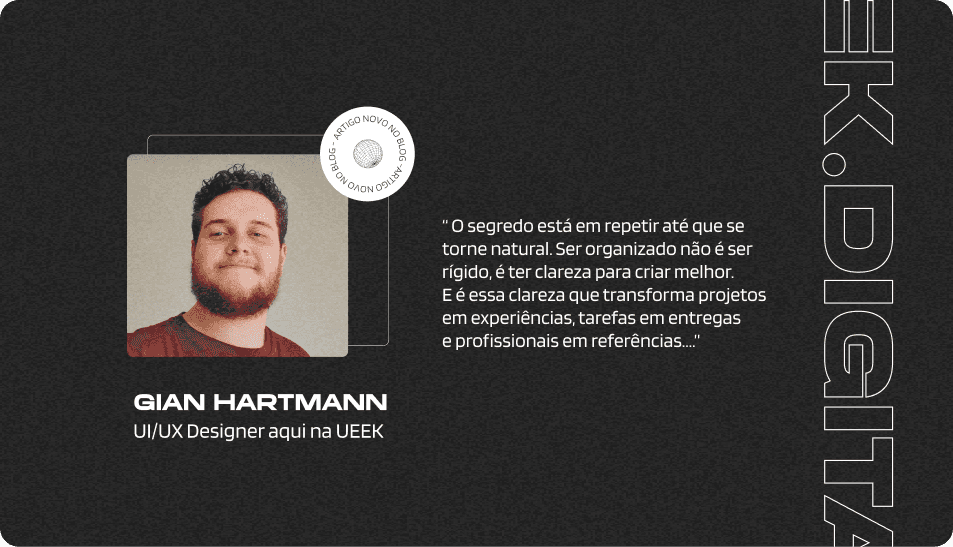
Organization is silent, but powerful. It does not appear in reports or commits, but it is reflected in the quality of everything that is delivered. Like any cultural habit, it is born slowly: a reminder, an adjustment, a review, a “let me fix this now.” The secret is to repeat it until it becomes natural. Being organized is not being rigid; it is having the clarity to create better. And it is this clarity that turns projects into experiences, tasks into deliveries, and professionals into references.
Organize a little today. Tomorrow it will be easier. And in some time, you will realize that this simple habit was what allowed you to grow, understand, and deliver with purpose.

LET'S TALK ABOUT YOUR PROJECT?
We help turn innovative ideas into reality, fix process flaws through digital solutions, and design interfaces that delight and engage. Committed to excellence and compliance with LGPD, we empower businesses to grow sustainably and securely.

ALL CASES
Technology Project Organization: Why Small Daily Habits Make All the Difference
•
10 min
Continuous Organization
In the fast-paced routine of technology, organization is often the first habit to be set aside. Ironically, it is precisely what sustains the pace, the clarity, and the delivery of consistent results. Being organized is not about making everything “pretty” or following a rigid method, but about creating a workflow that breathes, adapts, and sustains itself over time. When organization becomes part of a team’s culture, each delivery is clearer, each process is more predictable, and each person better understands what they are building. In an environment where change is constant and short deadlines are the norm, organization becomes the thread that connects chaos to productivity.
Organization is more about mindset than method
Technology professionals deal with countless variables: code versions, simultaneous tasks, shifting priorities, and information coming from every direction. In this scenario, organization is not a luxury; it is a survival mechanism. It works like an anchor amid chaos, helping turn “I need to fix this now” into “I know exactly where to make the change.” More than following methods or tools, being organized means having an eye that seeks to solve and keep what has been solved in order. It means understanding that clarity comes from small everyday decisions, such as naming a file correctly, reviewing the code before closing the editor, or keeping the backlog clean and up to date.
Think of a development sprint: if old tickets are not updated, the backlog quickly turns into a maze. Likewise, a designer who does not keep the hierarchy of frames and components in Figma ends up making collaboration harder and the project heavier and more confusing. Organization is precisely the habit of not letting buildup happen; it is reviewing, cleaning, and adjusting the path before it becomes a tangle that is hard to navigate. This discipline is not a block to creativity, but what allows it to happen more fluidly and productively, both in code and in design.
The daily construction of organization
Organization is not born complete; it is built in layers of consistency. There are reminders, alarms, quick notes, and daily reviews that reinforce behavior and create a personal culture of gentle but constant discipline. Small triggers that repeat and shape the habit of keeping everything in order. These simple gestures are more powerful than any great attempt to put everything in order at once. Disorganization is the result of small accumulated oversights, while organization is the reflection of continuous small care.
What distinguishes professionals who deliver predictably from those who live by improvisation is the ability to keep the flow organized, even while moving. It is reviewing what was done before ending the day, leaving files ready for the next cycle, and documenting what has already been completed. A developer who organizes their project folders, removes unnecessary lines of code, and writes explanatory comments is, in practice, ensuring that their future (and the team’s) will be more agile. The same goes for the UI designer who keeps the Design System updated, documents component variations, and standardizes colors and typography within the file. These are details that improve readability, understanding, and decision-making, making the work lighter and more efficient for everyone.
Organizing while doing: the secret to clarity
The biggest trap is believing that you can only organize after you finish something. In practice, the best time to organize is while you are doing it. Reviewing code during development, adjusting screens as new ideas arise, documenting what is already ready, and ensuring that each delivery is coherent before moving on to the next are attitudes that save time and avoid the buildup of rework. This micro-discipline creates a virtuous cycle of clarity and productivity.
In design, this means applying good practices from the start: naming frames and components clearly, grouping elements by function, following a consistent visual hierarchy, and keeping spacing and grids standardized. By doing this during the process, the file remains lightweight, understandable, and scalable. In the end, anyone who opens the project understands the logic and can continue the work without noise. Likewise, a developer who organizes commits and keeps the repository clean creates a solid foundation for the whole team to move forward with confidence. Organization during execution is synonymous with collective clarity.
When everything is in order, understanding of the project improves, communication flows naturally, and execution becomes lighter and more efficient. A well-structured file in Figma or clean code in a Git repository represent the same value: the translation of clarity into efficiency.
A culture of organization is a culture of delivery
In a technology team, organization is not an individual responsibility, but a shared culture built by the example of each member. When everyone keeps the code clean, updates task status, records learnings, and takes care of product consistency, the result is a continuous cycle of evolution. Organized teams deliver with more consistency and less effort because there is less noise between stages. Meetings become more objective, rework decreases, and collective focus increases. Delivery stops being the end of the process and becomes a natural stage of a well-orchestrated system.
In design, this culture is reflected in small patterns that become habits: following the same grid across different projects, applying design tokens consistently, centralizing components in a single library, and keeping visual documentation accessible to the entire team. When the design area is organized, it not only gains productivity, but also strengthens the brand’s visual identity and the product’s scalability. Organization is therefore a tool for consistency and collective evolution.
Organizing is an act of care for your own work, for the team’s time, and for the end user’s experience. When a project is built with clarity, it carries a signature of professionalism visible in every detail. Clean code, an organized interface, and well-written documentation are not just good practices; they are signs of respect for the product and the people involved. And when this culture spreads, the impact goes beyond productivity, directly influencing the quality and purpose of deliveries.
Conclusion
Organization is silent, but powerful. It does not appear in reports or commits, but it is reflected in the quality of everything that is delivered. Like any cultural habit, it is born slowly: a reminder, an adjustment, a review, a “let me fix this now.” The secret is to repeat it until it becomes natural. Being organized is not being rigid; it is having the clarity to create better. And it is this clarity that turns projects into experiences, tasks into deliveries, and professionals into references.
Organize a little today. Tomorrow it will be easier. And in some time, you will realize that this simple habit was what allowed you to grow, understand, and deliver with purpose.
LET'S TALK ABOUT YOUR PROJECT?
We help turn innovative ideas into reality, fix process flaws through digital solutions, and design interfaces that delight and engage. Committed to excellence and compliance with LGPD, we empower businesses to grow sustainably and securely.
ALL CASES
•
10 min
Technology Project Organization: Why Small Daily Habits Make All the Difference
Continuous Organization
In the fast-paced routine of technology, organization is often the first habit to be set aside. Ironically, it is precisely what sustains the pace, the clarity, and the delivery of consistent results. Being organized is not about making everything “pretty” or following a rigid method, but about creating a workflow that breathes, adapts, and sustains itself over time. When organization becomes part of a team’s culture, each delivery is clearer, each process is more predictable, and each person better understands what they are building. In an environment where change is constant and short deadlines are the norm, organization becomes the thread that connects chaos to productivity.
Organization is more about mindset than method
Technology professionals deal with countless variables: code versions, simultaneous tasks, shifting priorities, and information coming from every direction. In this scenario, organization is not a luxury; it is a survival mechanism. It works like an anchor amid chaos, helping turn “I need to fix this now” into “I know exactly where to make the change.” More than following methods or tools, being organized means having an eye that seeks to solve and keep what has been solved in order. It means understanding that clarity comes from small everyday decisions, such as naming a file correctly, reviewing the code before closing the editor, or keeping the backlog clean and up to date.
Think of a development sprint: if old tickets are not updated, the backlog quickly turns into a maze. Likewise, a designer who does not keep the hierarchy of frames and components in Figma ends up making collaboration harder and the project heavier and more confusing. Organization is precisely the habit of not letting buildup happen; it is reviewing, cleaning, and adjusting the path before it becomes a tangle that is hard to navigate. This discipline is not a block to creativity, but what allows it to happen more fluidly and productively, both in code and in design.
The daily construction of organization
Organization is not born complete; it is built in layers of consistency. There are reminders, alarms, quick notes, and daily reviews that reinforce behavior and create a personal culture of gentle but constant discipline. Small triggers that repeat and shape the habit of keeping everything in order. These simple gestures are more powerful than any great attempt to put everything in order at once. Disorganization is the result of small accumulated oversights, while organization is the reflection of continuous small care.
What distinguishes professionals who deliver predictably from those who live by improvisation is the ability to keep the flow organized, even while moving. It is reviewing what was done before ending the day, leaving files ready for the next cycle, and documenting what has already been completed. A developer who organizes their project folders, removes unnecessary lines of code, and writes explanatory comments is, in practice, ensuring that their future (and the team’s) will be more agile. The same goes for the UI designer who keeps the Design System updated, documents component variations, and standardizes colors and typography within the file. These are details that improve readability, understanding, and decision-making, making the work lighter and more efficient for everyone.
Organizing while doing: the secret to clarity
The biggest trap is believing that you can only organize after you finish something. In practice, the best time to organize is while you are doing it. Reviewing code during development, adjusting screens as new ideas arise, documenting what is already ready, and ensuring that each delivery is coherent before moving on to the next are attitudes that save time and avoid the buildup of rework. This micro-discipline creates a virtuous cycle of clarity and productivity.
In design, this means applying good practices from the start: naming frames and components clearly, grouping elements by function, following a consistent visual hierarchy, and keeping spacing and grids standardized. By doing this during the process, the file remains lightweight, understandable, and scalable. In the end, anyone who opens the project understands the logic and can continue the work without noise. Likewise, a developer who organizes commits and keeps the repository clean creates a solid foundation for the whole team to move forward with confidence. Organization during execution is synonymous with collective clarity.
When everything is in order, understanding of the project improves, communication flows naturally, and execution becomes lighter and more efficient. A well-structured file in Figma or clean code in a Git repository represent the same value: the translation of clarity into efficiency.
A culture of organization is a culture of delivery
In a technology team, organization is not an individual responsibility, but a shared culture built by the example of each member. When everyone keeps the code clean, updates task status, records learnings, and takes care of product consistency, the result is a continuous cycle of evolution. Organized teams deliver with more consistency and less effort because there is less noise between stages. Meetings become more objective, rework decreases, and collective focus increases. Delivery stops being the end of the process and becomes a natural stage of a well-orchestrated system.
In design, this culture is reflected in small patterns that become habits: following the same grid across different projects, applying design tokens consistently, centralizing components in a single library, and keeping visual documentation accessible to the entire team. When the design area is organized, it not only gains productivity, but also strengthens the brand’s visual identity and the product’s scalability. Organization is therefore a tool for consistency and collective evolution.
Organizing is an act of care for your own work, for the team’s time, and for the end user’s experience. When a project is built with clarity, it carries a signature of professionalism visible in every detail. Clean code, an organized interface, and well-written documentation are not just good practices; they are signs of respect for the product and the people involved. And when this culture spreads, the impact goes beyond productivity, directly influencing the quality and purpose of deliveries.
Conclusion
Organization is silent, but powerful. It does not appear in reports or commits, but it is reflected in the quality of everything that is delivered. Like any cultural habit, it is born slowly: a reminder, an adjustment, a review, a “let me fix this now.” The secret is to repeat it until it becomes natural. Being organized is not being rigid; it is having the clarity to create better. And it is this clarity that turns projects into experiences, tasks into deliveries, and professionals into references.
Organize a little today. Tomorrow it will be easier. And in some time, you will realize that this simple habit was what allowed you to grow, understand, and deliver with purpose.
LET'S TALK ABOUT YOUR PROJECT?
We help turn innovative ideas into reality, fix process flaws through digital solutions, and design interfaces that delight and engage. Committed to excellence and compliance with LGPD, we empower businesses to grow sustainably and securely.