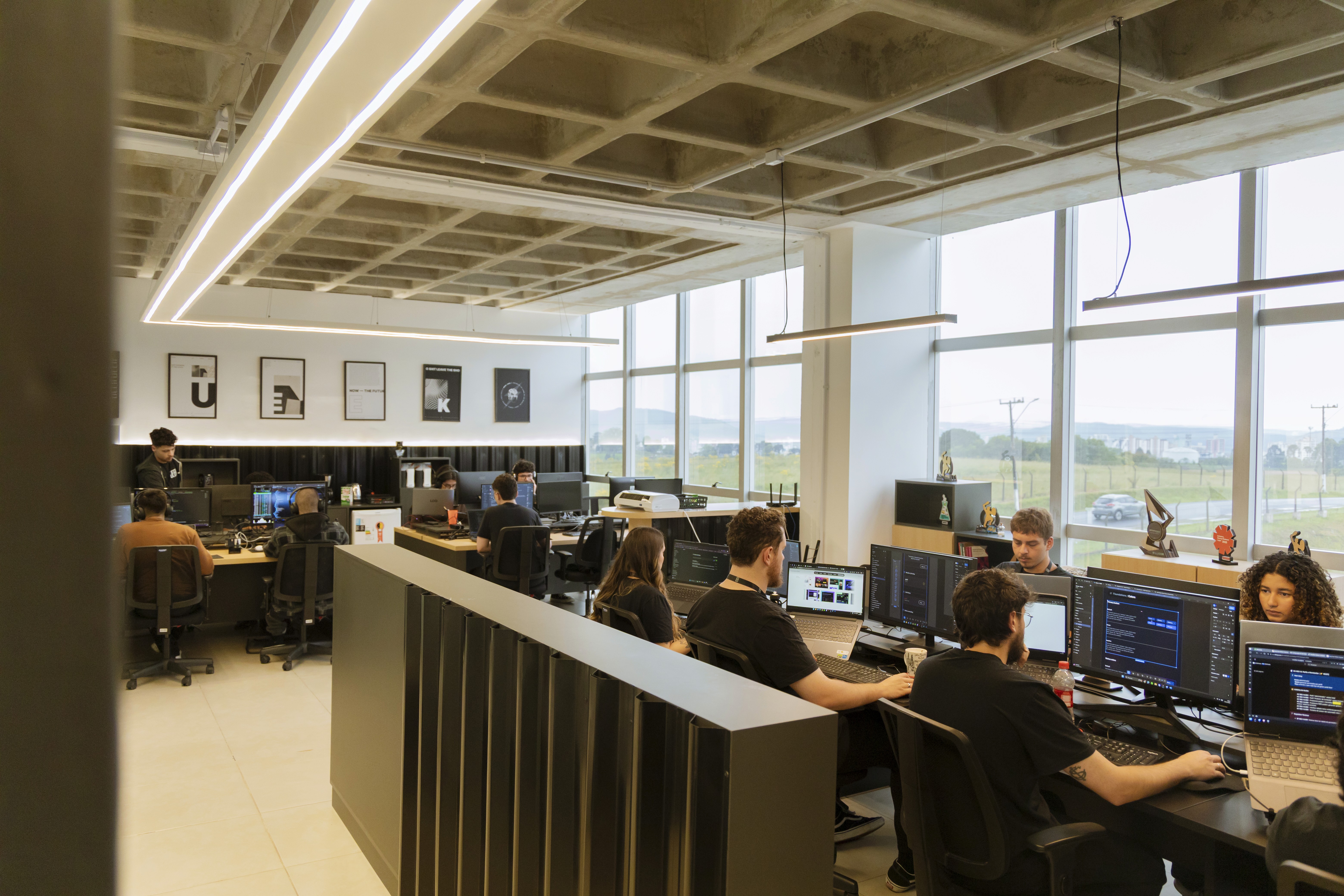
Digital projects do not start with design. They begin when a digital product, a system, or a platform is decided upon without clearly defining how that project will be technically sustained over time.
Before any UX design, UI design, or design system, digital projects already accumulate decisions that directly impact software development.
These decisions shape the structure of the digital product even when no interface has yet been designed. When this process is not carried out in a structured way, the impact appears later, usually at the moment when design is held accountable for results that depend much more on the technical foundation than on the visual layer.
The error, therefore, does not begin on the screen. It begins with the absence of structure before it.
What are digital projects?
Digital projects are initiatives that involve the creation, development, or evolution of solutions based on digital technology. Their goal is to solve a problem, improve processes, or create new products and services through software, platforms, or digital systems.
These projects typically go through stages such as requirements definition, design, development, testing, and launch, involving different areas such as product, design, technology, and business.
In practice, digital projects may include, for example:
mobile app development
web platform creation
internal system building
SaaS product development
creation of corporate portals and websites
implementation of digital solutions for companies
Unlike traditional projects, digital projects are often iterative and evolutionary, meaning they continue to be improved even after launch, with new features, performance enhancements, and adjustments based on real user usage.
In many cases, digital projects are part of digital transformation initiatives, helping companies modernize processes, integrate systems, and create new experiences for customers and users.
Digital projects go beyond visual deliverables
Digital projects cannot be treated as one-off deliverables. A digital product does not end when a website, an app, or a first functional version is published. It is a system in constant evolution, which begins to accumulate rules, data, technical dependencies, and decision paths from the very first moment.
Each choice made throughout software development adds layers to the digital product. When this evolution is not considered from the start, the project is born limited, requiring continuous adaptations and reactive solutions. The system grows, but without a foundation prepared to sustain that growth.
In this scenario, software development stops sustaining the evolution of the digital product and starts responding to structural problems that could have been avoided. This is the point where many digital projects begin to fail, even before design exists.
What happens before design in digital projects
Before design, digital projects already face fundamental decisions that, when not made explicit, become silent constraints. The absence of definition about what the digital product is, how far it goes, and how it should evolve creates an environment in which software development operates without clear direction.
Without a structured foundation, development responds to external stimuli, such as one-off requests, scope adjustments, and emergency demands. Software stops being a structuring force and becomes corrective. The digital product evolves through patchwork, not through interconnected decisions.
When design enters this context, it already finds an unstable system. The limitations that arise are neither visual nor conceptual. They are structural limitations, defined long before the first interface was designed.
Mistakes that happen before design in digital projects
The problems that appear in the interface are usually the result of structural mistakes made before design. Among the most common are:
Structural mistake before design | Impact on the digital product |
Digital product without clear boundaries | System grows in an unstructured way and is hard to sustain |
Decisions made without considering cumulative impact | Limited evolution and constant rework |
Lack of prioritization criteria | Software development reacts to pressure, not to strategy |
Technical boundaries not defined | Unfeasible promises and fragile solutions |
Evolution treated as correction | Product remains functional, but does not evolve |
Growth without long-term vision | Rigid structures or unnecessary complexity |
Diffuse technical responsibility | Decisions are lost and the system fragments |
Design absorbing structural problems | Limitations appear in the interface, not in the foundation |
These mistakes do not arise during design. They were already present when the digital product began to be built without structure.
When software development loses its structuring role
In mature digital projects, software development acts as the support for the evolution of the digital product. It defines boundaries, creates predictability, and enables consistent growth. In poorly structured projects, the opposite happens.
Without clear direction, development begins to operate in correction cycles. Each new demand requires adjustments that compromise previous decisions. The digital product continues to work, but loses its ability to adapt. Design, when it enters this scenario, starts dealing with constraints that are not visual, but structural.
At this point, failure is already underway. It only becomes visible in the interface.

Why failures happen before design
Digital projects fail before design because the technical foundation of the digital product is not defined. Software development starts without clear direction, critical decisions are made by omission, and the evolution of the system is not planned.
Design does not create these problems. It only reveals them.
When the digital product is structured as a system from the start and software development supports its evolution, design finds stable ground to act on. When that does not happen, the interface begins to carry problems that were never visual.
When we say that projects fail before design, we are not talking about an abstract or conceptual problem. Failures happen at specific points in the process, almost always before any formal creation stage begins.
The first point of failure usually occurs at the informal start of the project. Before any structured kick-off, decisions are already being made in sales conversations, message exchanges, or quick alignment meetings. At that moment, what the digital product “needs to be,” what seems simple, and what can wait until later are all defined. These decisions begin to guide software development without ever having been treated as structural decisions.
Next, the failure deepens in the transition between sales and execution. What was sold reaches the team as a concept, not as a structure. Expectations are created without technical validation, boundaries are not discussed, and priorities are not established. Software development begins already constrained by promises that have not gone through a structural filter. Design, when it enters, inherits a scenario that was already tense from the start.
Another critical point is the briefing that should function as a diagnosis. In many projects, the briefing is limited to collecting wishes, visual references, and lists of features. There is no clear stage for defining the digital product problem, nor for translating these expectations into decisions that guide software development. Design receives information, but not direction.
There is also a recurring failure at the moment when initial technical decisions should be taken. There is always a point where someone would need to define what is structural, what is flexible, and what compromises the evolution of the digital product. When no one takes on this role, decisions happen by omission. Software development ends up deciding in the middle of execution, not before it.
Another mistake happens because of the absence of a clear checkpoint before design. Few projects stop to assess whether the foundation is mature enough to become an interface. Without this validation point, design starts too early and becomes the place where structural problems are discovered, instead of merely materialized.
Even when design is well executed, failures arise in the transition between design and software development. Unrecorded decisions, implicit criteria, and informal agreements cause the digital product to start drifting away from what was intended. Execution begins to interpret intentions, rather than follow clear decisions.
The failure points that come before design
The table below summarizes where these failures occur in the process and how they end up manifesting once design is already underway.
What fails before design | Where the failure happens in the process | How the problem appears in design |
Poorly defined product problem | Initial conversations and superficial briefing | Screens try to solve different pain points at the same time |
Product treated as a one-off deliverable | Initial planning of the digital product | Interface grows without clear logic |
Initial scope not delimited | Sales → execution transition | Design has to accommodate everything at once |
Technical decisions by omission | Start of software development | Limitations arise during screen design |
Lack of prioritization criteria | Project evolution without direction | Confusing UX, with long or redundant flows |
Lack of a pre-design checkpoint | Hasty start of creation | Design becomes a space for discovering problems |
Diffuse technical responsibility | Throughout the entire project | Constant visual adjustments to work around structural flaws |
Design does not create these problems. It only makes visible decisions that were already wrong or incomplete before the first screen existed.
How UEEK acts before design
UEEK's work begins before any interface because we understand that design should not be the point where structural problems are discovered. Our initial work is to organize decisions that usually remain implicit in the project.
Before design, we work on reading the digital product as a system, delimiting its core, dependencies, and evolution limits. We structure initial technical decisions that condition the rest of the project, making explicit what is flexible, what is critical, and what cannot be decided reactively.
This stage is not for choosing technologies or speeding up delivery, but for creating a technical foundation that allows design to operate clearly, without taking on responsibilities that are not its own.
Technical continuity throughout the project
Structuring before design does not solve the problem if the decisions are not sustained over time. Many projects start well and get lost as they evolve.
UEEK acts as a layer of technical continuity, ensuring that structural decisions are not lost between phases, people, or deliverables. We maintain technical coherence, protect the criteria defined at the start, and evaluate changes based on the accumulated impact on the digital product.
This support prevents software development from becoming corrective and allows the project to evolve without losing shape, even when new demands arise.
Risk reduction for agencies and studios
One of UEEK's main roles as a technical partner is to reduce the risk that falls on agencies and studios in complex digital projects.
When there is a structured technical layer, the agency stops negotiating opinion and starts negotiating feasibility. Promises are assessed before being accepted, boundaries are made explicit, and decisions begin to follow technical criteria.
This reduces rework, strain with end clients, and situations in which design has to justify limitations that were born long before visual creation.

LET'S TALK ABOUT YOUR PROJECT?
We help turn innovative ideas into reality, fix process flaws through digital solutions, and design interfaces that delight and engage. Committed to excellence and compliance with LGPD, we empower businesses to grow sustainably and securely.

ALL CASES
Why projects fail before the design
•
10 min
Digital projects do not start with design. They begin when a digital product, a system, or a platform is decided upon without clearly defining how that project will be technically sustained over time.
Before any UX design, UI design, or design system, digital projects already accumulate decisions that directly impact software development.
These decisions shape the structure of the digital product even when no interface has yet been designed. When this process is not carried out in a structured way, the impact appears later, usually at the moment when design is held accountable for results that depend much more on the technical foundation than on the visual layer.
The error, therefore, does not begin on the screen. It begins with the absence of structure before it.
What are digital projects?
Digital projects are initiatives that involve the creation, development, or evolution of solutions based on digital technology. Their goal is to solve a problem, improve processes, or create new products and services through software, platforms, or digital systems.
These projects typically go through stages such as requirements definition, design, development, testing, and launch, involving different areas such as product, design, technology, and business.
In practice, digital projects may include, for example:
mobile app development
web platform creation
internal system building
SaaS product development
creation of corporate portals and websites
implementation of digital solutions for companies
Unlike traditional projects, digital projects are often iterative and evolutionary, meaning they continue to be improved even after launch, with new features, performance enhancements, and adjustments based on real user usage.
In many cases, digital projects are part of digital transformation initiatives, helping companies modernize processes, integrate systems, and create new experiences for customers and users.
Digital projects go beyond visual deliverables
Digital projects cannot be treated as one-off deliverables. A digital product does not end when a website, an app, or a first functional version is published. It is a system in constant evolution, which begins to accumulate rules, data, technical dependencies, and decision paths from the very first moment.
Each choice made throughout software development adds layers to the digital product. When this evolution is not considered from the start, the project is born limited, requiring continuous adaptations and reactive solutions. The system grows, but without a foundation prepared to sustain that growth.
In this scenario, software development stops sustaining the evolution of the digital product and starts responding to structural problems that could have been avoided. This is the point where many digital projects begin to fail, even before design exists.
What happens before design in digital projects
Before design, digital projects already face fundamental decisions that, when not made explicit, become silent constraints. The absence of definition about what the digital product is, how far it goes, and how it should evolve creates an environment in which software development operates without clear direction.
Without a structured foundation, development responds to external stimuli, such as one-off requests, scope adjustments, and emergency demands. Software stops being a structuring force and becomes corrective. The digital product evolves through patchwork, not through interconnected decisions.
When design enters this context, it already finds an unstable system. The limitations that arise are neither visual nor conceptual. They are structural limitations, defined long before the first interface was designed.
Mistakes that happen before design in digital projects
The problems that appear in the interface are usually the result of structural mistakes made before design. Among the most common are:
Structural mistake before design | Impact on the digital product |
Digital product without clear boundaries | System grows in an unstructured way and is hard to sustain |
Decisions made without considering cumulative impact | Limited evolution and constant rework |
Lack of prioritization criteria | Software development reacts to pressure, not to strategy |
Technical boundaries not defined | Unfeasible promises and fragile solutions |
Evolution treated as correction | Product remains functional, but does not evolve |
Growth without long-term vision | Rigid structures or unnecessary complexity |
Diffuse technical responsibility | Decisions are lost and the system fragments |
Design absorbing structural problems | Limitations appear in the interface, not in the foundation |
These mistakes do not arise during design. They were already present when the digital product began to be built without structure.
When software development loses its structuring role
In mature digital projects, software development acts as the support for the evolution of the digital product. It defines boundaries, creates predictability, and enables consistent growth. In poorly structured projects, the opposite happens.
Without clear direction, development begins to operate in correction cycles. Each new demand requires adjustments that compromise previous decisions. The digital product continues to work, but loses its ability to adapt. Design, when it enters this scenario, starts dealing with constraints that are not visual, but structural.
At this point, failure is already underway. It only becomes visible in the interface.
Why failures happen before design
Digital projects fail before design because the technical foundation of the digital product is not defined. Software development starts without clear direction, critical decisions are made by omission, and the evolution of the system is not planned.
Design does not create these problems. It only reveals them.
When the digital product is structured as a system from the start and software development supports its evolution, design finds stable ground to act on. When that does not happen, the interface begins to carry problems that were never visual.
When we say that projects fail before design, we are not talking about an abstract or conceptual problem. Failures happen at specific points in the process, almost always before any formal creation stage begins.
The first point of failure usually occurs at the informal start of the project. Before any structured kick-off, decisions are already being made in sales conversations, message exchanges, or quick alignment meetings. At that moment, what the digital product “needs to be,” what seems simple, and what can wait until later are all defined. These decisions begin to guide software development without ever having been treated as structural decisions.
Next, the failure deepens in the transition between sales and execution. What was sold reaches the team as a concept, not as a structure. Expectations are created without technical validation, boundaries are not discussed, and priorities are not established. Software development begins already constrained by promises that have not gone through a structural filter. Design, when it enters, inherits a scenario that was already tense from the start.
Another critical point is the briefing that should function as a diagnosis. In many projects, the briefing is limited to collecting wishes, visual references, and lists of features. There is no clear stage for defining the digital product problem, nor for translating these expectations into decisions that guide software development. Design receives information, but not direction.
There is also a recurring failure at the moment when initial technical decisions should be taken. There is always a point where someone would need to define what is structural, what is flexible, and what compromises the evolution of the digital product. When no one takes on this role, decisions happen by omission. Software development ends up deciding in the middle of execution, not before it.
Another mistake happens because of the absence of a clear checkpoint before design. Few projects stop to assess whether the foundation is mature enough to become an interface. Without this validation point, design starts too early and becomes the place where structural problems are discovered, instead of merely materialized.
Even when design is well executed, failures arise in the transition between design and software development. Unrecorded decisions, implicit criteria, and informal agreements cause the digital product to start drifting away from what was intended. Execution begins to interpret intentions, rather than follow clear decisions.
The failure points that come before design
The table below summarizes where these failures occur in the process and how they end up manifesting once design is already underway.
What fails before design | Where the failure happens in the process | How the problem appears in design |
Poorly defined product problem | Initial conversations and superficial briefing | Screens try to solve different pain points at the same time |
Product treated as a one-off deliverable | Initial planning of the digital product | Interface grows without clear logic |
Initial scope not delimited | Sales → execution transition | Design has to accommodate everything at once |
Technical decisions by omission | Start of software development | Limitations arise during screen design |
Lack of prioritization criteria | Project evolution without direction | Confusing UX, with long or redundant flows |
Lack of a pre-design checkpoint | Hasty start of creation | Design becomes a space for discovering problems |
Diffuse technical responsibility | Throughout the entire project | Constant visual adjustments to work around structural flaws |
Design does not create these problems. It only makes visible decisions that were already wrong or incomplete before the first screen existed.
How UEEK acts before design
UEEK's work begins before any interface because we understand that design should not be the point where structural problems are discovered. Our initial work is to organize decisions that usually remain implicit in the project.
Before design, we work on reading the digital product as a system, delimiting its core, dependencies, and evolution limits. We structure initial technical decisions that condition the rest of the project, making explicit what is flexible, what is critical, and what cannot be decided reactively.
This stage is not for choosing technologies or speeding up delivery, but for creating a technical foundation that allows design to operate clearly, without taking on responsibilities that are not its own.
Technical continuity throughout the project
Structuring before design does not solve the problem if the decisions are not sustained over time. Many projects start well and get lost as they evolve.
UEEK acts as a layer of technical continuity, ensuring that structural decisions are not lost between phases, people, or deliverables. We maintain technical coherence, protect the criteria defined at the start, and evaluate changes based on the accumulated impact on the digital product.
This support prevents software development from becoming corrective and allows the project to evolve without losing shape, even when new demands arise.
Risk reduction for agencies and studios
One of UEEK's main roles as a technical partner is to reduce the risk that falls on agencies and studios in complex digital projects.
When there is a structured technical layer, the agency stops negotiating opinion and starts negotiating feasibility. Promises are assessed before being accepted, boundaries are made explicit, and decisions begin to follow technical criteria.
This reduces rework, strain with end clients, and situations in which design has to justify limitations that were born long before visual creation.
LET'S TALK ABOUT YOUR PROJECT?
We help turn innovative ideas into reality, fix process flaws through digital solutions, and design interfaces that delight and engage. Committed to excellence and compliance with LGPD, we empower businesses to grow sustainably and securely.
ALL CASES
•
10 min
Why projects fail before the design
Digital projects do not start with design. They begin when a digital product, a system, or a platform is decided upon without clearly defining how that project will be technically sustained over time.
Before any UX design, UI design, or design system, digital projects already accumulate decisions that directly impact software development.
These decisions shape the structure of the digital product even when no interface has yet been designed. When this process is not carried out in a structured way, the impact appears later, usually at the moment when design is held accountable for results that depend much more on the technical foundation than on the visual layer.
The error, therefore, does not begin on the screen. It begins with the absence of structure before it.
What are digital projects?
Digital projects are initiatives that involve the creation, development, or evolution of solutions based on digital technology. Their goal is to solve a problem, improve processes, or create new products and services through software, platforms, or digital systems.
These projects typically go through stages such as requirements definition, design, development, testing, and launch, involving different areas such as product, design, technology, and business.
In practice, digital projects may include, for example:
mobile app development
web platform creation
internal system building
SaaS product development
creation of corporate portals and websites
implementation of digital solutions for companies
Unlike traditional projects, digital projects are often iterative and evolutionary, meaning they continue to be improved even after launch, with new features, performance enhancements, and adjustments based on real user usage.
In many cases, digital projects are part of digital transformation initiatives, helping companies modernize processes, integrate systems, and create new experiences for customers and users.
Digital projects go beyond visual deliverables
Digital projects cannot be treated as one-off deliverables. A digital product does not end when a website, an app, or a first functional version is published. It is a system in constant evolution, which begins to accumulate rules, data, technical dependencies, and decision paths from the very first moment.
Each choice made throughout software development adds layers to the digital product. When this evolution is not considered from the start, the project is born limited, requiring continuous adaptations and reactive solutions. The system grows, but without a foundation prepared to sustain that growth.
In this scenario, software development stops sustaining the evolution of the digital product and starts responding to structural problems that could have been avoided. This is the point where many digital projects begin to fail, even before design exists.
What happens before design in digital projects
Before design, digital projects already face fundamental decisions that, when not made explicit, become silent constraints. The absence of definition about what the digital product is, how far it goes, and how it should evolve creates an environment in which software development operates without clear direction.
Without a structured foundation, development responds to external stimuli, such as one-off requests, scope adjustments, and emergency demands. Software stops being a structuring force and becomes corrective. The digital product evolves through patchwork, not through interconnected decisions.
When design enters this context, it already finds an unstable system. The limitations that arise are neither visual nor conceptual. They are structural limitations, defined long before the first interface was designed.
Mistakes that happen before design in digital projects
The problems that appear in the interface are usually the result of structural mistakes made before design. Among the most common are:
Structural mistake before design | Impact on the digital product |
Digital product without clear boundaries | System grows in an unstructured way and is hard to sustain |
Decisions made without considering cumulative impact | Limited evolution and constant rework |
Lack of prioritization criteria | Software development reacts to pressure, not to strategy |
Technical boundaries not defined | Unfeasible promises and fragile solutions |
Evolution treated as correction | Product remains functional, but does not evolve |
Growth without long-term vision | Rigid structures or unnecessary complexity |
Diffuse technical responsibility | Decisions are lost and the system fragments |
Design absorbing structural problems | Limitations appear in the interface, not in the foundation |
These mistakes do not arise during design. They were already present when the digital product began to be built without structure.
When software development loses its structuring role
In mature digital projects, software development acts as the support for the evolution of the digital product. It defines boundaries, creates predictability, and enables consistent growth. In poorly structured projects, the opposite happens.
Without clear direction, development begins to operate in correction cycles. Each new demand requires adjustments that compromise previous decisions. The digital product continues to work, but loses its ability to adapt. Design, when it enters this scenario, starts dealing with constraints that are not visual, but structural.
At this point, failure is already underway. It only becomes visible in the interface.
Why failures happen before design
Digital projects fail before design because the technical foundation of the digital product is not defined. Software development starts without clear direction, critical decisions are made by omission, and the evolution of the system is not planned.
Design does not create these problems. It only reveals them.
When the digital product is structured as a system from the start and software development supports its evolution, design finds stable ground to act on. When that does not happen, the interface begins to carry problems that were never visual.
When we say that projects fail before design, we are not talking about an abstract or conceptual problem. Failures happen at specific points in the process, almost always before any formal creation stage begins.
The first point of failure usually occurs at the informal start of the project. Before any structured kick-off, decisions are already being made in sales conversations, message exchanges, or quick alignment meetings. At that moment, what the digital product “needs to be,” what seems simple, and what can wait until later are all defined. These decisions begin to guide software development without ever having been treated as structural decisions.
Next, the failure deepens in the transition between sales and execution. What was sold reaches the team as a concept, not as a structure. Expectations are created without technical validation, boundaries are not discussed, and priorities are not established. Software development begins already constrained by promises that have not gone through a structural filter. Design, when it enters, inherits a scenario that was already tense from the start.
Another critical point is the briefing that should function as a diagnosis. In many projects, the briefing is limited to collecting wishes, visual references, and lists of features. There is no clear stage for defining the digital product problem, nor for translating these expectations into decisions that guide software development. Design receives information, but not direction.
There is also a recurring failure at the moment when initial technical decisions should be taken. There is always a point where someone would need to define what is structural, what is flexible, and what compromises the evolution of the digital product. When no one takes on this role, decisions happen by omission. Software development ends up deciding in the middle of execution, not before it.
Another mistake happens because of the absence of a clear checkpoint before design. Few projects stop to assess whether the foundation is mature enough to become an interface. Without this validation point, design starts too early and becomes the place where structural problems are discovered, instead of merely materialized.
Even when design is well executed, failures arise in the transition between design and software development. Unrecorded decisions, implicit criteria, and informal agreements cause the digital product to start drifting away from what was intended. Execution begins to interpret intentions, rather than follow clear decisions.
The failure points that come before design
The table below summarizes where these failures occur in the process and how they end up manifesting once design is already underway.
What fails before design | Where the failure happens in the process | How the problem appears in design |
Poorly defined product problem | Initial conversations and superficial briefing | Screens try to solve different pain points at the same time |
Product treated as a one-off deliverable | Initial planning of the digital product | Interface grows without clear logic |
Initial scope not delimited | Sales → execution transition | Design has to accommodate everything at once |
Technical decisions by omission | Start of software development | Limitations arise during screen design |
Lack of prioritization criteria | Project evolution without direction | Confusing UX, with long or redundant flows |
Lack of a pre-design checkpoint | Hasty start of creation | Design becomes a space for discovering problems |
Diffuse technical responsibility | Throughout the entire project | Constant visual adjustments to work around structural flaws |
Design does not create these problems. It only makes visible decisions that were already wrong or incomplete before the first screen existed.
How UEEK acts before design
UEEK's work begins before any interface because we understand that design should not be the point where structural problems are discovered. Our initial work is to organize decisions that usually remain implicit in the project.
Before design, we work on reading the digital product as a system, delimiting its core, dependencies, and evolution limits. We structure initial technical decisions that condition the rest of the project, making explicit what is flexible, what is critical, and what cannot be decided reactively.
This stage is not for choosing technologies or speeding up delivery, but for creating a technical foundation that allows design to operate clearly, without taking on responsibilities that are not its own.
Technical continuity throughout the project
Structuring before design does not solve the problem if the decisions are not sustained over time. Many projects start well and get lost as they evolve.
UEEK acts as a layer of technical continuity, ensuring that structural decisions are not lost between phases, people, or deliverables. We maintain technical coherence, protect the criteria defined at the start, and evaluate changes based on the accumulated impact on the digital product.
This support prevents software development from becoming corrective and allows the project to evolve without losing shape, even when new demands arise.
Risk reduction for agencies and studios
One of UEEK's main roles as a technical partner is to reduce the risk that falls on agencies and studios in complex digital projects.
When there is a structured technical layer, the agency stops negotiating opinion and starts negotiating feasibility. Promises are assessed before being accepted, boundaries are made explicit, and decisions begin to follow technical criteria.
This reduces rework, strain with end clients, and situations in which design has to justify limitations that were born long before visual creation.
LET'S TALK ABOUT YOUR PROJECT?
We help turn innovative ideas into reality, fix process flaws through digital solutions, and design interfaces that delight and engage. Committed to excellence and compliance with LGPD, we empower businesses to grow sustainably and securely.