
In many digital projects, agencies and creative studios come in when the project is already underway. The scope has already been presented, the deadline has already been agreed upon, and business decisions have already been made.
At that point, design begins to evolve and development needs to keep up. The problem is that, often, the technical foundation has not yet been clearly structured.
That's when friction, rework, and limitations begin to appear that are not visual, but structural.
At UEEK, we act as the technical and operational extension of agencies and studios at exactly this point. Our role is to help organize decisions that need to happen before design: defining software requirements, separating functional requirements from non-functional requirements, and structuring the technical foundation that supports the digital product over time.
Understanding why starting without clear requirements compromises the project is not just a technical matter. It is a way to reduce risk, protect creative work, and ensure that design and development move forward on a solid foundation, not on assumptions.
What are software requirements
Software requirements are clear and verifiable descriptions that define what a system must do and under what conditions it must operate. They guide technical decisions, software development, and design itself, serving as a common reference between business, product, design, and engineering.
In practice, software requirements delimit the behavior, rules, limits, and expectations of the digital product. When they do not exist or are vague, the project advances through interpretation, and decisions start being made during execution, not before it.
Software requirements: examples
Examples of software requirements include allowing user registration, processing payments, generating reports, responding to actions within a certain time, or ensuring minimum security levels. These examples show that requirements are not limited to visible functionalities, but also to conditions under which the system operates.
Types of software requirements
What are the types of software requirements?
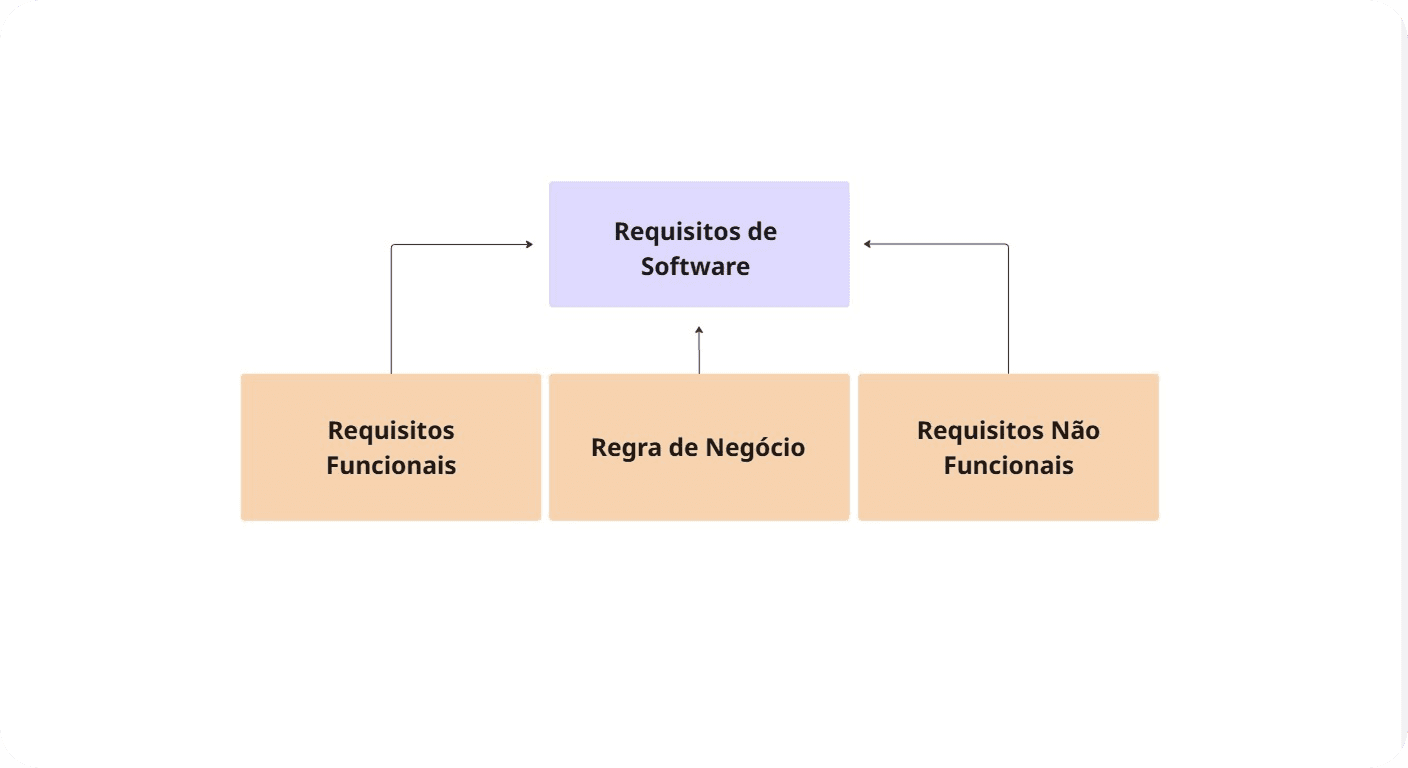
The types of software requirements are, mainly, functional requirements and non-functional requirements. This division makes it possible to separate what the system does from the conditions under which it must operate, making technical decisions before design easier.
When a project begins, one of the first technical decisions is to understand what type of software requirements need to be defined. This distinction is not conceptual. It directly affects how the product will be built, maintained, and evolved over time.
In practice, software requirements are organized into two major groups: functional requirements and non-functional requirements. Each group answers different questions and plays a specific role in the development of the digital product.
Ignoring this separation usually creates projects that work at the beginning, but show limitations as they grow.
Functional and non-functional requirements
Functional requirements define what the system must do, describing the digital product's features, rules, and flows, such as allowing user registration, generating reports, or processing payments.
Non-functional requirements, on the other hand, define how the system should behave, establishing conditions for performance, security, reliability, and scalability that support those functionalities.
Together, functional requirements and non-functional requirements form the technical foundation of the software and need to be defined before design to avoid improvised decisions during development.
What are FR and NFR?
FR is the abbreviation for functional requirements, which describe the functionalities and behaviors the software must offer, that is, what the system does.
NFR is the abbreviation for non-functional requirements, which define how the system should behave, establishing conditions for performance, security, reliability, scalability, and maintainability.
Both are types of software requirements and need to be defined before design to properly guide development.
Functional requirements
What are the functional requirements?
Functional requirements are all the definitions that describe what the software must do to serve users and the business. They include features such as user registration and authentication, access permissions, creation and editing flows for data, information processing, report generation, integrations with other systems, and rules that determine how each action should happen within the digital product. These functional requirements directly guide software development and need to be clear before design.
Functional requirements describe the expected behaviors of the system. They define which actions the digital product needs to allow, which rules need to be respected, and how the main flows should happen.
These requirements are the foundation for software development and directly guide the design of flows and interactions in design.
Decision levels of functional requirements
Business level
Related to the goal the product needs to meet, such as enabling a new service or making an operating model viable.
User level
Describes what the person can do within the system to achieve that goal.
Technical level
Details specific behaviors the system needs to perform to make the other levels possible.
This organization helps maintain consistency between vision, use, and implementation.
Functional requirements: example
An example of a functional requirement is defining that the system must allow the user to create an account, log in, edit personal data, and perform specific actions according to their access profile. This type of functional requirement clearly describes the expected behavior of the software and directly guides development before design.
Allow user authentication
Enable creation and editing of records
Control access permissions
Generate reports based on system data
When these requirements are not clearly defined, software development starts deciding behavior during execution, which creates inconsistency and rework.
Non-functional requirements
Non-functional software requirements define the conditions under which the system must operate. They do not deal with specific functionalities, but with characteristics that ensure the stability, performance, and sustainability of the digital product over time.
These requirements establish clear limits for technical decisions and directly influence the software architecture, the necessary infrastructure, and the way the system will be maintained and evolved.
Classification of non-functional requirements
Product characteristics
Related to internal system behavior, such as performance, reliability, usability, and portability.
Organizational constraints
Linked to technical standards, internal policies, delivery processes, implementation guidelines, and technologies adopted by the organization.
External requirements
Imposed by factors outside the project, such as legal issues, data privacy, interoperability with other systems, and security requirements.
In addition to this classification, non-functional requirements can also be understood as software quality attributes. They are what determine whether the system functions within acceptable parameters for the user and for operations.
Quality attributes
Performance
Defines the system's response speed to certain actions, such as the maximum time to execute an operation or the number of transactions the system can process simultaneously.
Usability
Refers to how easily users learn to use the system, understand its flows, and complete tasks without difficulty or excessive error.
Reliability
Deals with the system's ability to operate correctly for a given period, maintaining predictable behavior even under heavy usage conditions.
Security
Involves protection against unauthorized access, data leakage, and attacks. A common example is the requirement to store sensitive information using appropriate encryption mechanisms.
Scalability
Describes the system's ability to grow and handle increases in users, data, or transaction volume without significant loss of performance or stability.
Common examples of non-functional requirements include:
Define the system's maximum response time
Establish the capacity to support growth in users
Ensure minimum security criteria
Ensure ease of maintenance over time
These requirements need to be defined early because they affect all system functionalities. They are not one-off adjustments or details that can be resolved only during implementation.
Non-functional requirements: example
An example of a non-functional requirement is defining that the system must respond to user actions within two seconds, even with multiple users accessing it at the same time. This non-functional requirement does not describe a specific functionality, but establishes a performance condition that guides technical and architectural decisions before design and development.
What are the 5 stages of requirements analysis?
Software requirements analysis is organized into five fundamental stages. These stages structure the definition of functional requirements and non-functional requirements before design and software development, ensuring alignment, predictability, and reduced rework throughout the project.
The stages are:
Elicitation
Documentation
Validation
Management
Verification and approval
1. Requirements elicitation
Software requirements elicitation is the stage in which the needs, expectations, and constraints of the stakeholders involved in the project are identified. The goal is not only to collect information, but to understand the context in which the digital product will be used and which problems it needs to solve.
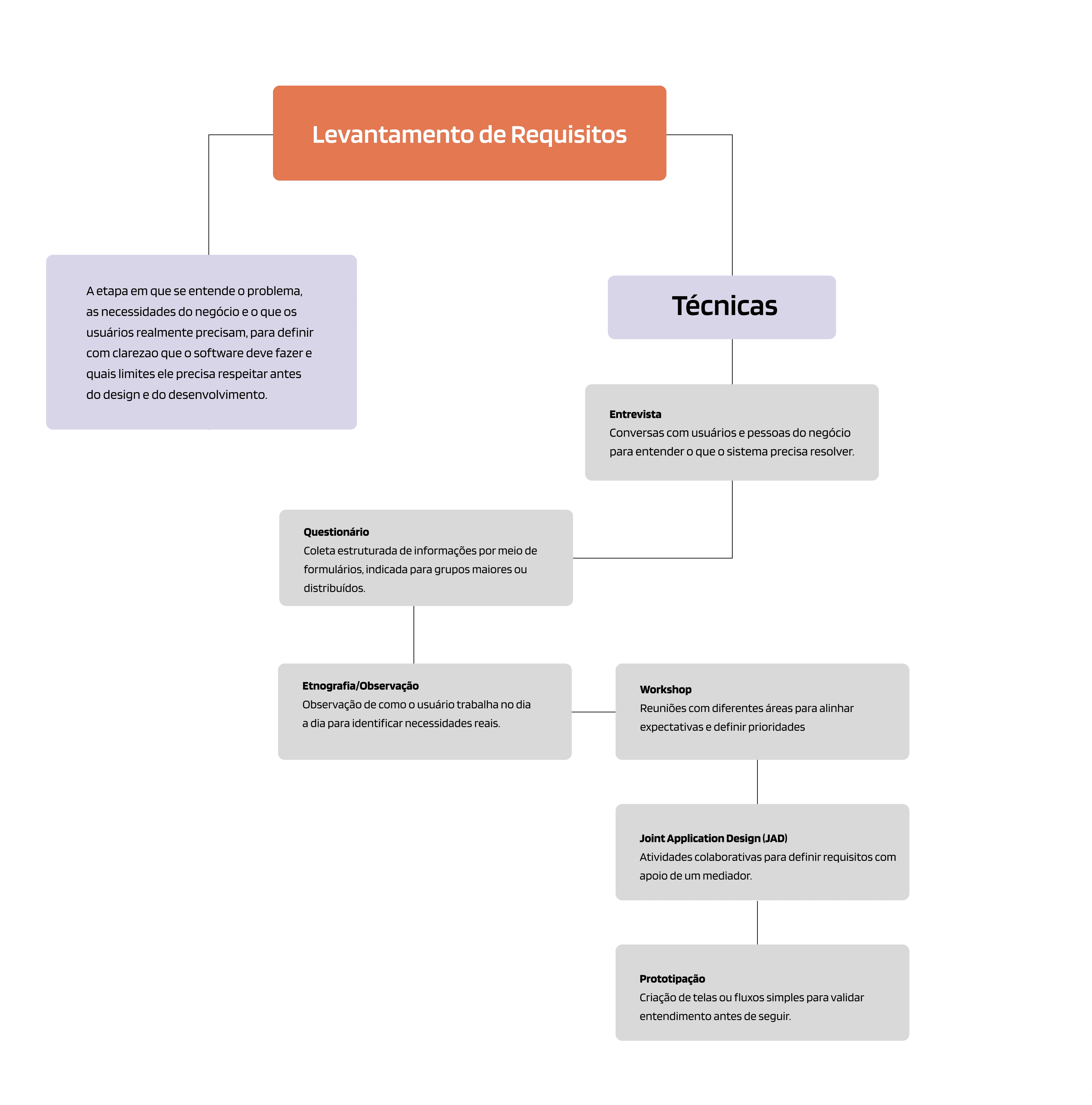
To ensure that software requirements are reliable and suited to the system's reality, it is important to use structured collection methods. Among the most common are:
Interviews with stakeholders, which allow you to delve into needs and goals through direct conversations with people involved in the project.
Requirements workshops, which bring different areas together to discuss and align expectations collaboratively, speeding up decisions and reducing noise.
Questionnaires, used when it is necessary to collect information in larger volumes, in a standardized and organized way.
Observation of real use, which involves following users in their work environment or analyzing behavior through monitoring tools to identify needs that are not always verbalized.
The definition of functional requirements and non-functional requirements is a continuous and collaborative process. It involves clients, end users, Product Managers, Product Owners, development teams, and analysts, and should not be limited to a single moment in the project.
2. Requirements documentation
Software requirements documentation clearly organizes and records the functional requirements, non-functional requirements, business rules, and technical constraints of the system. This documentation serves as a reference for all subsequent stages of the project.
There are different ways to document software requirements, and the choice depends on the product's complexity and the level of formality required. Among the most common approaches are:
Specification documents, such as the software requirements document (SRS) or functional specification documents, which describe in detail the expected behavior of the system.
Diagrams, which help visualize flows, dependencies, and interactions between parts of the system, making understanding easier for technical and non-technical teams.
Models, such as business process or data modeling, which help analyze functional and non-functional aspects of the software.
Documentation is not there to make the project bureaucratic, but to preserve decisions and reduce ambiguity throughout development.
3. Requirements validation
The validation of software requirements aims to confirm whether the documented requirements are correct, complete, and understood by everyone involved. In this stage, the goal is to identify inconsistencies, gaps, or divergent interpretations before development begins.
Some common validation techniques include:
Structured reviews, conducted with stakeholders and technical specialists, such as Tech Leads, to check consistency and feasibility.
Prototyping, which uses simplified models to allow users and teams to visualize flows and provide feedback before full implementation.
Simulations, which assess how the system may behave in different usage scenarios.
Validating functional requirements and non-functional requirements before design reduces late adjustments and protects the creative process.
4. Requirements management
Software requirements management is responsible for controlling changes throughout the project. Whenever a functional or non-functional requirement needs to be changed, that change must be recorded, evaluated, and approved before being applied.
This stage prevents the project from evolving in an unstructured way and ensures traceability of decisions. To support this process, management tools are used that allow versioning, change history, and impact analysis.
Managing requirements does not mean preventing changes, but ensuring they happen consciously and aligned with the product's goals.
5. Verification and approval
Verification and approval of software requirements correspond to the final review of definitions before starting software design and development. In this stage, the functional requirements and non-functional requirements are evaluated for consistency, completeness, and alignment with business and user expectations.
Formal approval creates a point of stability in the project, reducing rework and ensuring the digital product moves forward with clear criteria. It is this stage that allows design to start with a solid technical foundation, instead of discovering structural problems during execution.
When functional requirements and non-functional requirements are clearly defined, the project no longer advances by assumption. Decisions have criteria, development gains direction, and design works on a stable foundation. This is the point where software begins to be built as a system, not just as a deliverable.
How do you perform requirements analysis?
Requirements analysis begins by organizing decisions that are usually implicit in the project. The focus is on understanding what the system needs to do, under what conditions it should operate, and what technical constraints already exist.
Here at UEEK, this process happens together with agencies and studios, acting as technical support to turn initial alignments into clear functional requirements and non-functional requirements, validated before design and development.

What is the difference between functional requirements and business rules?
Functional requirements describe the system's behavior, that is, the functionalities the software must perform to serve users and processes. Business rules, on the other hand, define business policies, conditions, and constraints, such as calculations, limits, exceptions, or decision criteria.
Business rules guide and influence functional requirements, but they are not the same thing: the rule defines what must be respected, while the functional requirement defines how the system will apply that rule.
What are the 7 phases of a project?
The seven phases of a software project are usually organized as:
Initiation
Requirements analysis
Planning
Design
Development
Testing
Delivery or evolution
During initiation, the problem and project objectives are defined. During requirements analysis, functional and non-functional requirements are structured. During planning, deadlines, resources, and scope are organized.
In design, decisions are translated into flows and interfaces. In development, the software is implemented. In testing, the system is validated. Finally, in delivery or evolution, the product is put into use and improved over time.
How to describe functional requirements
The description of functional requirements needs to be clear and objective to guide software development and avoid interpretations during execution. A well-described functional requirement defines exactly the expected behavior of the system before design.
Indicate who performs the action
Clearly describe what the system must do
State under which conditions the action occurs
Focus on observable behavior
Avoid vague or subjective terms
How to identify functional and non-functional requirements?
Identifying functional requirements and non-functional requirements begins with the way questions are asked during the analysis. Functional requirements are identified by answering what the system needs to do, describing actions, flows, and operating rules.
Non-functional requirements are identified by answering how the system should behave, defining conditions of performance, security, reliability, scalability, and maintenance.
Separating these two perspectives helps structure the project correctly before design and guides technical decisions more clearly.

LET'S TALK ABOUT YOUR PROJECT?
We help turn innovative ideas into reality, fix process flaws through digital solutions, and design interfaces that delight and engage. Committed to excellence and compliance with LGPD, we empower businesses to grow sustainably and securely.

ALL CASES
Software Requirements: what they are and why they are important
•
15 min
In many digital projects, agencies and creative studios come in when the project is already underway. The scope has already been presented, the deadline has already been agreed upon, and business decisions have already been made.
At that point, design begins to evolve and development needs to keep up. The problem is that, often, the technical foundation has not yet been clearly structured.
That's when friction, rework, and limitations begin to appear that are not visual, but structural.
At UEEK, we act as the technical and operational extension of agencies and studios at exactly this point. Our role is to help organize decisions that need to happen before design: defining software requirements, separating functional requirements from non-functional requirements, and structuring the technical foundation that supports the digital product over time.
Understanding why starting without clear requirements compromises the project is not just a technical matter. It is a way to reduce risk, protect creative work, and ensure that design and development move forward on a solid foundation, not on assumptions.
What are software requirements
Software requirements are clear and verifiable descriptions that define what a system must do and under what conditions it must operate. They guide technical decisions, software development, and design itself, serving as a common reference between business, product, design, and engineering.
In practice, software requirements delimit the behavior, rules, limits, and expectations of the digital product. When they do not exist or are vague, the project advances through interpretation, and decisions start being made during execution, not before it.
Software requirements: examples
Examples of software requirements include allowing user registration, processing payments, generating reports, responding to actions within a certain time, or ensuring minimum security levels. These examples show that requirements are not limited to visible functionalities, but also to conditions under which the system operates.
Types of software requirements
What are the types of software requirements?
The types of software requirements are, mainly, functional requirements and non-functional requirements. This division makes it possible to separate what the system does from the conditions under which it must operate, making technical decisions before design easier.
When a project begins, one of the first technical decisions is to understand what type of software requirements need to be defined. This distinction is not conceptual. It directly affects how the product will be built, maintained, and evolved over time.
In practice, software requirements are organized into two major groups: functional requirements and non-functional requirements. Each group answers different questions and plays a specific role in the development of the digital product.
Ignoring this separation usually creates projects that work at the beginning, but show limitations as they grow.
Functional and non-functional requirements
Functional requirements define what the system must do, describing the digital product's features, rules, and flows, such as allowing user registration, generating reports, or processing payments.
Non-functional requirements, on the other hand, define how the system should behave, establishing conditions for performance, security, reliability, and scalability that support those functionalities.
Together, functional requirements and non-functional requirements form the technical foundation of the software and need to be defined before design to avoid improvised decisions during development.
What are FR and NFR?
FR is the abbreviation for functional requirements, which describe the functionalities and behaviors the software must offer, that is, what the system does.
NFR is the abbreviation for non-functional requirements, which define how the system should behave, establishing conditions for performance, security, reliability, scalability, and maintainability.
Both are types of software requirements and need to be defined before design to properly guide development.
Functional requirements
What are the functional requirements?
Functional requirements are all the definitions that describe what the software must do to serve users and the business. They include features such as user registration and authentication, access permissions, creation and editing flows for data, information processing, report generation, integrations with other systems, and rules that determine how each action should happen within the digital product. These functional requirements directly guide software development and need to be clear before design.
Functional requirements describe the expected behaviors of the system. They define which actions the digital product needs to allow, which rules need to be respected, and how the main flows should happen.
These requirements are the foundation for software development and directly guide the design of flows and interactions in design.
Decision levels of functional requirements
Business level
Related to the goal the product needs to meet, such as enabling a new service or making an operating model viable.
User level
Describes what the person can do within the system to achieve that goal.
Technical level
Details specific behaviors the system needs to perform to make the other levels possible.
This organization helps maintain consistency between vision, use, and implementation.
Functional requirements: example
An example of a functional requirement is defining that the system must allow the user to create an account, log in, edit personal data, and perform specific actions according to their access profile. This type of functional requirement clearly describes the expected behavior of the software and directly guides development before design.
Allow user authentication
Enable creation and editing of records
Control access permissions
Generate reports based on system data
When these requirements are not clearly defined, software development starts deciding behavior during execution, which creates inconsistency and rework.
Non-functional requirements
Non-functional software requirements define the conditions under which the system must operate. They do not deal with specific functionalities, but with characteristics that ensure the stability, performance, and sustainability of the digital product over time.
These requirements establish clear limits for technical decisions and directly influence the software architecture, the necessary infrastructure, and the way the system will be maintained and evolved.
Classification of non-functional requirements
Product characteristics
Related to internal system behavior, such as performance, reliability, usability, and portability.
Organizational constraints
Linked to technical standards, internal policies, delivery processes, implementation guidelines, and technologies adopted by the organization.
External requirements
Imposed by factors outside the project, such as legal issues, data privacy, interoperability with other systems, and security requirements.
In addition to this classification, non-functional requirements can also be understood as software quality attributes. They are what determine whether the system functions within acceptable parameters for the user and for operations.
Quality attributes
Performance
Defines the system's response speed to certain actions, such as the maximum time to execute an operation or the number of transactions the system can process simultaneously.
Usability
Refers to how easily users learn to use the system, understand its flows, and complete tasks without difficulty or excessive error.
Reliability
Deals with the system's ability to operate correctly for a given period, maintaining predictable behavior even under heavy usage conditions.
Security
Involves protection against unauthorized access, data leakage, and attacks. A common example is the requirement to store sensitive information using appropriate encryption mechanisms.
Scalability
Describes the system's ability to grow and handle increases in users, data, or transaction volume without significant loss of performance or stability.
Common examples of non-functional requirements include:
Define the system's maximum response time
Establish the capacity to support growth in users
Ensure minimum security criteria
Ensure ease of maintenance over time
These requirements need to be defined early because they affect all system functionalities. They are not one-off adjustments or details that can be resolved only during implementation.
Non-functional requirements: example
An example of a non-functional requirement is defining that the system must respond to user actions within two seconds, even with multiple users accessing it at the same time. This non-functional requirement does not describe a specific functionality, but establishes a performance condition that guides technical and architectural decisions before design and development.
What are the 5 stages of requirements analysis?
Software requirements analysis is organized into five fundamental stages. These stages structure the definition of functional requirements and non-functional requirements before design and software development, ensuring alignment, predictability, and reduced rework throughout the project.
The stages are:
Elicitation
Documentation
Validation
Management
Verification and approval
1. Requirements elicitation
Software requirements elicitation is the stage in which the needs, expectations, and constraints of the stakeholders involved in the project are identified. The goal is not only to collect information, but to understand the context in which the digital product will be used and which problems it needs to solve.
To ensure that software requirements are reliable and suited to the system's reality, it is important to use structured collection methods. Among the most common are:
Interviews with stakeholders, which allow you to delve into needs and goals through direct conversations with people involved in the project.
Requirements workshops, which bring different areas together to discuss and align expectations collaboratively, speeding up decisions and reducing noise.
Questionnaires, used when it is necessary to collect information in larger volumes, in a standardized and organized way.
Observation of real use, which involves following users in their work environment or analyzing behavior through monitoring tools to identify needs that are not always verbalized.
The definition of functional requirements and non-functional requirements is a continuous and collaborative process. It involves clients, end users, Product Managers, Product Owners, development teams, and analysts, and should not be limited to a single moment in the project.
2. Requirements documentation
Software requirements documentation clearly organizes and records the functional requirements, non-functional requirements, business rules, and technical constraints of the system. This documentation serves as a reference for all subsequent stages of the project.
There are different ways to document software requirements, and the choice depends on the product's complexity and the level of formality required. Among the most common approaches are:
Specification documents, such as the software requirements document (SRS) or functional specification documents, which describe in detail the expected behavior of the system.
Diagrams, which help visualize flows, dependencies, and interactions between parts of the system, making understanding easier for technical and non-technical teams.
Models, such as business process or data modeling, which help analyze functional and non-functional aspects of the software.
Documentation is not there to make the project bureaucratic, but to preserve decisions and reduce ambiguity throughout development.
3. Requirements validation
The validation of software requirements aims to confirm whether the documented requirements are correct, complete, and understood by everyone involved. In this stage, the goal is to identify inconsistencies, gaps, or divergent interpretations before development begins.
Some common validation techniques include:
Structured reviews, conducted with stakeholders and technical specialists, such as Tech Leads, to check consistency and feasibility.
Prototyping, which uses simplified models to allow users and teams to visualize flows and provide feedback before full implementation.
Simulations, which assess how the system may behave in different usage scenarios.
Validating functional requirements and non-functional requirements before design reduces late adjustments and protects the creative process.
4. Requirements management
Software requirements management is responsible for controlling changes throughout the project. Whenever a functional or non-functional requirement needs to be changed, that change must be recorded, evaluated, and approved before being applied.
This stage prevents the project from evolving in an unstructured way and ensures traceability of decisions. To support this process, management tools are used that allow versioning, change history, and impact analysis.
Managing requirements does not mean preventing changes, but ensuring they happen consciously and aligned with the product's goals.
5. Verification and approval
Verification and approval of software requirements correspond to the final review of definitions before starting software design and development. In this stage, the functional requirements and non-functional requirements are evaluated for consistency, completeness, and alignment with business and user expectations.
Formal approval creates a point of stability in the project, reducing rework and ensuring the digital product moves forward with clear criteria. It is this stage that allows design to start with a solid technical foundation, instead of discovering structural problems during execution.
When functional requirements and non-functional requirements are clearly defined, the project no longer advances by assumption. Decisions have criteria, development gains direction, and design works on a stable foundation. This is the point where software begins to be built as a system, not just as a deliverable.
How do you perform requirements analysis?
Requirements analysis begins by organizing decisions that are usually implicit in the project. The focus is on understanding what the system needs to do, under what conditions it should operate, and what technical constraints already exist.
Here at UEEK, this process happens together with agencies and studios, acting as technical support to turn initial alignments into clear functional requirements and non-functional requirements, validated before design and development.
What is the difference between functional requirements and business rules?
Functional requirements describe the system's behavior, that is, the functionalities the software must perform to serve users and processes. Business rules, on the other hand, define business policies, conditions, and constraints, such as calculations, limits, exceptions, or decision criteria.
Business rules guide and influence functional requirements, but they are not the same thing: the rule defines what must be respected, while the functional requirement defines how the system will apply that rule.
What are the 7 phases of a project?
The seven phases of a software project are usually organized as:
Initiation
Requirements analysis
Planning
Design
Development
Testing
Delivery or evolution
During initiation, the problem and project objectives are defined. During requirements analysis, functional and non-functional requirements are structured. During planning, deadlines, resources, and scope are organized.
In design, decisions are translated into flows and interfaces. In development, the software is implemented. In testing, the system is validated. Finally, in delivery or evolution, the product is put into use and improved over time.
How to describe functional requirements
The description of functional requirements needs to be clear and objective to guide software development and avoid interpretations during execution. A well-described functional requirement defines exactly the expected behavior of the system before design.
Indicate who performs the action
Clearly describe what the system must do
State under which conditions the action occurs
Focus on observable behavior
Avoid vague or subjective terms
How to identify functional and non-functional requirements?
Identifying functional requirements and non-functional requirements begins with the way questions are asked during the analysis. Functional requirements are identified by answering what the system needs to do, describing actions, flows, and operating rules.
Non-functional requirements are identified by answering how the system should behave, defining conditions of performance, security, reliability, scalability, and maintenance.
Separating these two perspectives helps structure the project correctly before design and guides technical decisions more clearly.
LET'S TALK ABOUT YOUR PROJECT?
We help turn innovative ideas into reality, fix process flaws through digital solutions, and design interfaces that delight and engage. Committed to excellence and compliance with LGPD, we empower businesses to grow sustainably and securely.
ALL CASES
•
15 min
Software Requirements: what they are and why they are important
In many digital projects, agencies and creative studios come in when the project is already underway. The scope has already been presented, the deadline has already been agreed upon, and business decisions have already been made.
At that point, design begins to evolve and development needs to keep up. The problem is that, often, the technical foundation has not yet been clearly structured.
That's when friction, rework, and limitations begin to appear that are not visual, but structural.
At UEEK, we act as the technical and operational extension of agencies and studios at exactly this point. Our role is to help organize decisions that need to happen before design: defining software requirements, separating functional requirements from non-functional requirements, and structuring the technical foundation that supports the digital product over time.
Understanding why starting without clear requirements compromises the project is not just a technical matter. It is a way to reduce risk, protect creative work, and ensure that design and development move forward on a solid foundation, not on assumptions.
What are software requirements
Software requirements are clear and verifiable descriptions that define what a system must do and under what conditions it must operate. They guide technical decisions, software development, and design itself, serving as a common reference between business, product, design, and engineering.
In practice, software requirements delimit the behavior, rules, limits, and expectations of the digital product. When they do not exist or are vague, the project advances through interpretation, and decisions start being made during execution, not before it.
Software requirements: examples
Examples of software requirements include allowing user registration, processing payments, generating reports, responding to actions within a certain time, or ensuring minimum security levels. These examples show that requirements are not limited to visible functionalities, but also to conditions under which the system operates.
Types of software requirements
What are the types of software requirements?
The types of software requirements are, mainly, functional requirements and non-functional requirements. This division makes it possible to separate what the system does from the conditions under which it must operate, making technical decisions before design easier.
When a project begins, one of the first technical decisions is to understand what type of software requirements need to be defined. This distinction is not conceptual. It directly affects how the product will be built, maintained, and evolved over time.
In practice, software requirements are organized into two major groups: functional requirements and non-functional requirements. Each group answers different questions and plays a specific role in the development of the digital product.
Ignoring this separation usually creates projects that work at the beginning, but show limitations as they grow.
Functional and non-functional requirements
Functional requirements define what the system must do, describing the digital product's features, rules, and flows, such as allowing user registration, generating reports, or processing payments.
Non-functional requirements, on the other hand, define how the system should behave, establishing conditions for performance, security, reliability, and scalability that support those functionalities.
Together, functional requirements and non-functional requirements form the technical foundation of the software and need to be defined before design to avoid improvised decisions during development.
What are FR and NFR?
FR is the abbreviation for functional requirements, which describe the functionalities and behaviors the software must offer, that is, what the system does.
NFR is the abbreviation for non-functional requirements, which define how the system should behave, establishing conditions for performance, security, reliability, scalability, and maintainability.
Both are types of software requirements and need to be defined before design to properly guide development.
Functional requirements
What are the functional requirements?
Functional requirements are all the definitions that describe what the software must do to serve users and the business. They include features such as user registration and authentication, access permissions, creation and editing flows for data, information processing, report generation, integrations with other systems, and rules that determine how each action should happen within the digital product. These functional requirements directly guide software development and need to be clear before design.
Functional requirements describe the expected behaviors of the system. They define which actions the digital product needs to allow, which rules need to be respected, and how the main flows should happen.
These requirements are the foundation for software development and directly guide the design of flows and interactions in design.
Decision levels of functional requirements
Business level
Related to the goal the product needs to meet, such as enabling a new service or making an operating model viable.
User level
Describes what the person can do within the system to achieve that goal.
Technical level
Details specific behaviors the system needs to perform to make the other levels possible.
This organization helps maintain consistency between vision, use, and implementation.
Functional requirements: example
An example of a functional requirement is defining that the system must allow the user to create an account, log in, edit personal data, and perform specific actions according to their access profile. This type of functional requirement clearly describes the expected behavior of the software and directly guides development before design.
Allow user authentication
Enable creation and editing of records
Control access permissions
Generate reports based on system data
When these requirements are not clearly defined, software development starts deciding behavior during execution, which creates inconsistency and rework.
Non-functional requirements
Non-functional software requirements define the conditions under which the system must operate. They do not deal with specific functionalities, but with characteristics that ensure the stability, performance, and sustainability of the digital product over time.
These requirements establish clear limits for technical decisions and directly influence the software architecture, the necessary infrastructure, and the way the system will be maintained and evolved.
Classification of non-functional requirements
Product characteristics
Related to internal system behavior, such as performance, reliability, usability, and portability.
Organizational constraints
Linked to technical standards, internal policies, delivery processes, implementation guidelines, and technologies adopted by the organization.
External requirements
Imposed by factors outside the project, such as legal issues, data privacy, interoperability with other systems, and security requirements.
In addition to this classification, non-functional requirements can also be understood as software quality attributes. They are what determine whether the system functions within acceptable parameters for the user and for operations.
Quality attributes
Performance
Defines the system's response speed to certain actions, such as the maximum time to execute an operation or the number of transactions the system can process simultaneously.
Usability
Refers to how easily users learn to use the system, understand its flows, and complete tasks without difficulty or excessive error.
Reliability
Deals with the system's ability to operate correctly for a given period, maintaining predictable behavior even under heavy usage conditions.
Security
Involves protection against unauthorized access, data leakage, and attacks. A common example is the requirement to store sensitive information using appropriate encryption mechanisms.
Scalability
Describes the system's ability to grow and handle increases in users, data, or transaction volume without significant loss of performance or stability.
Common examples of non-functional requirements include:
Define the system's maximum response time
Establish the capacity to support growth in users
Ensure minimum security criteria
Ensure ease of maintenance over time
These requirements need to be defined early because they affect all system functionalities. They are not one-off adjustments or details that can be resolved only during implementation.
Non-functional requirements: example
An example of a non-functional requirement is defining that the system must respond to user actions within two seconds, even with multiple users accessing it at the same time. This non-functional requirement does not describe a specific functionality, but establishes a performance condition that guides technical and architectural decisions before design and development.
What are the 5 stages of requirements analysis?
Software requirements analysis is organized into five fundamental stages. These stages structure the definition of functional requirements and non-functional requirements before design and software development, ensuring alignment, predictability, and reduced rework throughout the project.
The stages are:
Elicitation
Documentation
Validation
Management
Verification and approval
1. Requirements elicitation
Software requirements elicitation is the stage in which the needs, expectations, and constraints of the stakeholders involved in the project are identified. The goal is not only to collect information, but to understand the context in which the digital product will be used and which problems it needs to solve.
To ensure that software requirements are reliable and suited to the system's reality, it is important to use structured collection methods. Among the most common are:
Interviews with stakeholders, which allow you to delve into needs and goals through direct conversations with people involved in the project.
Requirements workshops, which bring different areas together to discuss and align expectations collaboratively, speeding up decisions and reducing noise.
Questionnaires, used when it is necessary to collect information in larger volumes, in a standardized and organized way.
Observation of real use, which involves following users in their work environment or analyzing behavior through monitoring tools to identify needs that are not always verbalized.
The definition of functional requirements and non-functional requirements is a continuous and collaborative process. It involves clients, end users, Product Managers, Product Owners, development teams, and analysts, and should not be limited to a single moment in the project.
2. Requirements documentation
Software requirements documentation clearly organizes and records the functional requirements, non-functional requirements, business rules, and technical constraints of the system. This documentation serves as a reference for all subsequent stages of the project.
There are different ways to document software requirements, and the choice depends on the product's complexity and the level of formality required. Among the most common approaches are:
Specification documents, such as the software requirements document (SRS) or functional specification documents, which describe in detail the expected behavior of the system.
Diagrams, which help visualize flows, dependencies, and interactions between parts of the system, making understanding easier for technical and non-technical teams.
Models, such as business process or data modeling, which help analyze functional and non-functional aspects of the software.
Documentation is not there to make the project bureaucratic, but to preserve decisions and reduce ambiguity throughout development.
3. Requirements validation
The validation of software requirements aims to confirm whether the documented requirements are correct, complete, and understood by everyone involved. In this stage, the goal is to identify inconsistencies, gaps, or divergent interpretations before development begins.
Some common validation techniques include:
Structured reviews, conducted with stakeholders and technical specialists, such as Tech Leads, to check consistency and feasibility.
Prototyping, which uses simplified models to allow users and teams to visualize flows and provide feedback before full implementation.
Simulations, which assess how the system may behave in different usage scenarios.
Validating functional requirements and non-functional requirements before design reduces late adjustments and protects the creative process.
4. Requirements management
Software requirements management is responsible for controlling changes throughout the project. Whenever a functional or non-functional requirement needs to be changed, that change must be recorded, evaluated, and approved before being applied.
This stage prevents the project from evolving in an unstructured way and ensures traceability of decisions. To support this process, management tools are used that allow versioning, change history, and impact analysis.
Managing requirements does not mean preventing changes, but ensuring they happen consciously and aligned with the product's goals.
5. Verification and approval
Verification and approval of software requirements correspond to the final review of definitions before starting software design and development. In this stage, the functional requirements and non-functional requirements are evaluated for consistency, completeness, and alignment with business and user expectations.
Formal approval creates a point of stability in the project, reducing rework and ensuring the digital product moves forward with clear criteria. It is this stage that allows design to start with a solid technical foundation, instead of discovering structural problems during execution.
When functional requirements and non-functional requirements are clearly defined, the project no longer advances by assumption. Decisions have criteria, development gains direction, and design works on a stable foundation. This is the point where software begins to be built as a system, not just as a deliverable.
How do you perform requirements analysis?
Requirements analysis begins by organizing decisions that are usually implicit in the project. The focus is on understanding what the system needs to do, under what conditions it should operate, and what technical constraints already exist.
Here at UEEK, this process happens together with agencies and studios, acting as technical support to turn initial alignments into clear functional requirements and non-functional requirements, validated before design and development.
What is the difference between functional requirements and business rules?
Functional requirements describe the system's behavior, that is, the functionalities the software must perform to serve users and processes. Business rules, on the other hand, define business policies, conditions, and constraints, such as calculations, limits, exceptions, or decision criteria.
Business rules guide and influence functional requirements, but they are not the same thing: the rule defines what must be respected, while the functional requirement defines how the system will apply that rule.
What are the 7 phases of a project?
The seven phases of a software project are usually organized as:
Initiation
Requirements analysis
Planning
Design
Development
Testing
Delivery or evolution
During initiation, the problem and project objectives are defined. During requirements analysis, functional and non-functional requirements are structured. During planning, deadlines, resources, and scope are organized.
In design, decisions are translated into flows and interfaces. In development, the software is implemented. In testing, the system is validated. Finally, in delivery or evolution, the product is put into use and improved over time.
How to describe functional requirements
The description of functional requirements needs to be clear and objective to guide software development and avoid interpretations during execution. A well-described functional requirement defines exactly the expected behavior of the system before design.
Indicate who performs the action
Clearly describe what the system must do
State under which conditions the action occurs
Focus on observable behavior
Avoid vague or subjective terms
How to identify functional and non-functional requirements?
Identifying functional requirements and non-functional requirements begins with the way questions are asked during the analysis. Functional requirements are identified by answering what the system needs to do, describing actions, flows, and operating rules.
Non-functional requirements are identified by answering how the system should behave, defining conditions of performance, security, reliability, scalability, and maintenance.
Separating these two perspectives helps structure the project correctly before design and guides technical decisions more clearly.
LET'S TALK ABOUT YOUR PROJECT?
We help turn innovative ideas into reality, fix process flaws through digital solutions, and design interfaces that delight and engage. Committed to excellence and compliance with LGPD, we empower businesses to grow sustainably and securely.