
Discover how custom web systems can transform your company’s operations by connecting data, teams, and decisions efficiently.
When we talk about digitally transforming a business, many people still imagine something distant, expensive, or “over the top” for the company’s current moment.
But let’s be honest?
In 2025, a good system is no longer a differentiator. It’s the basics.
But what is a good system, anyway?
We’re not just talking about having a pretty or modern platform. A truly good system is one that solves problems, integrates processes, avoids rework, and speeds up decisions.
It’s the tool that runs in the background, but changes everything in practice. It connects departments, automates whatever is possible, organizes data, and delivers strategic information without freezing, without breaking, no hassle.
Why is this the foundation of your growth?
Imagine growing and realizing your digital structure no longer keeps up. That the system that “used to get by” is now preventing your team from going further.
Businesses that want to scale need systems that keep up with that pace. And that doesn’t mean something complex or rigid. On the contrary, a good system is lightweight, flexible, and tailor-made for your reality.
The difference between an ordinary system and a strategic system
An ordinary system is one that performs a function. It “solves” something at a specific point. Sometimes it was bought in a hurry, or inherited from another phase of the company, and ended up becoming what “we have for today.” A strategic system goes further. It integrates with the business as part of the machinery.
This type of system:
automates repetitive tasks (freeing up the team’s time and mental bandwidth)
centralizes important information (reducing errors and rework)
makes decision-making easier (with real, accessible data)
adapts as the company grows
Why does this matter so much in 2025?
The business landscape has changed. Growth cycles are faster, consumer behavior changes frequently, and pressure for efficiency is present in every sector.
Today, companies that grow without a solid digital foundation face a dangerous scenario: the more they scale, the more problems they accumulate.
Spreadsheets that used to be enough now freeze up. Isolated systems that once “worked well” start not talking to each other. Information gets lost. Teams fall out of sync. Chaos sets in. And the problem is not growth. It’s the lack of structure to support it.
The invisible role of a well-built system
A good system doesn’t show itself. It runs behind the scenes, without freezing, without making you stop, without becoming a bottleneck. And precisely for that reason, it’s essential.
Well-built systems organize data, automate processes, avoid rework, and deliver information clearly. All of this without relying on the team’s juggling act.
In the end, the right system is the one that frees you up to focus on what really matters: strategy, customers, and innovation.
Systems that connect: how technology brings people, data, and decisions closer together
When we talk about web systems, it’s common to imagine something purely technical. Lines of code, screens, features. But the truth is that a well-made system goes far beyond the operational side.
It transforms the way people work, communicate, and make decisions within the company.
And that makes all the difference.
Departments that didn’t talk to each other start to understand one another
In many companies, teams operate in silos. Sales doesn’t know what the customer service team promised. Finance takes time to access billing data.
Production is left in the dark about deadlines and priorities. This creates noise, rework, delivery failures, and a lot of avoidable stress.
With a connected system, this scenario changes. Information flows between departments. What was confusing becomes clear. What was manual becomes automatic.
What was out of sync starts moving in harmony. And all of this happens naturally, because the right system doesn’t require effort to work. It simply fits into daily routines.
Data that used to be scattered now tells a story
Another key point: well-designed systems organize data. They capture, process, and display information in a visual and accessible way. This gives the team a real view of operations.
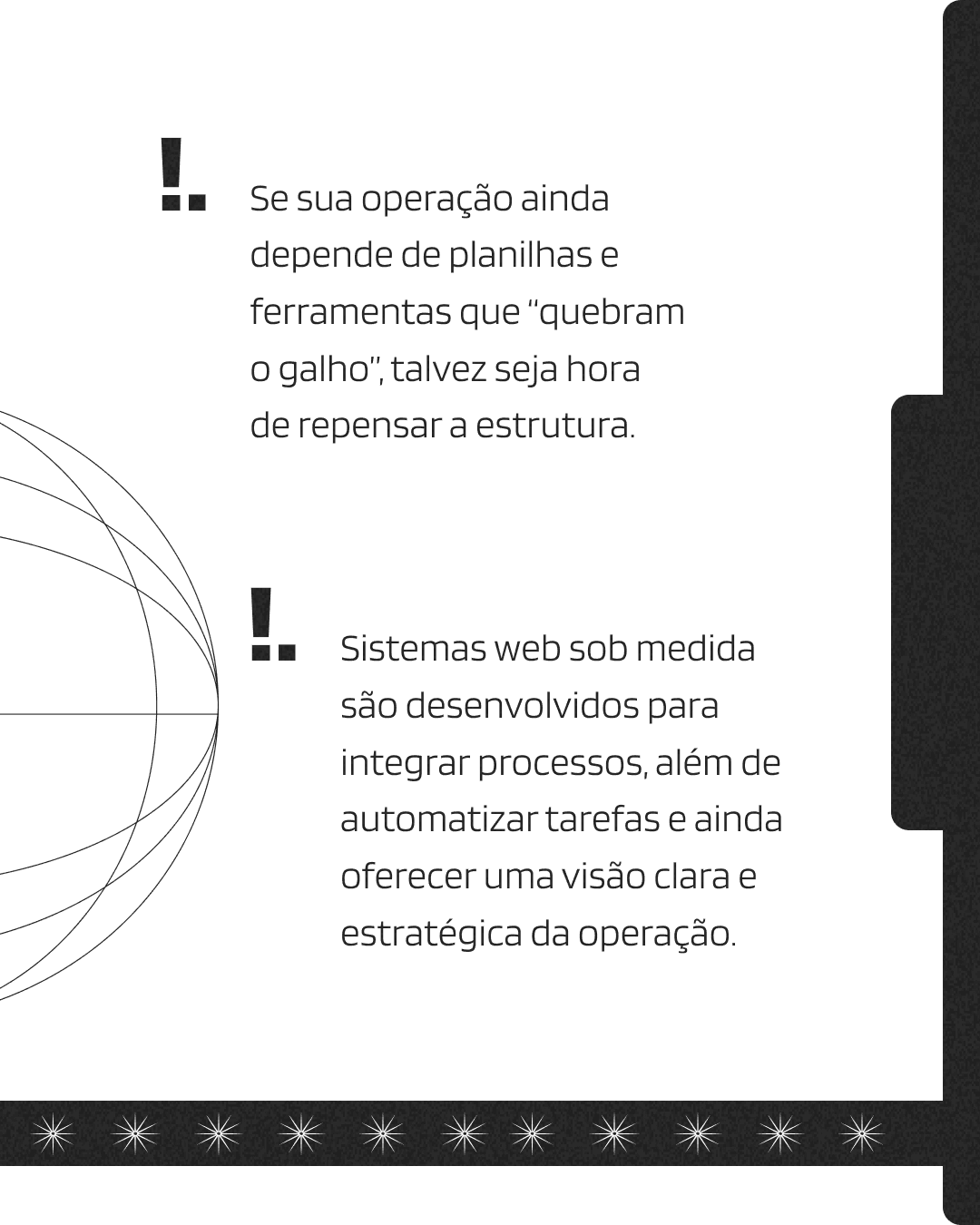
And that’s where web systems come in: tailor-made solutions designed to connect processes, integrate data, automate tasks, and bring more agility to day-to-day operations.
It allows for faster action, based on facts, not guesses. And when everyone has access to the same information, decisions are faster, more accurate, and more aligned with the company’s goals.
That’s when the system becomes a strategic partner, not just a tool.
Technology that improves the atmosphere and the culture
It may sound like an exaggeration, but a system also affects the organizational climate. Teams that work with good tools feel less overloaded. They feel that work flows.
They stop wasting time on repetitive tasks or endless searches for information. And this directly influences motivation, productivity, and even engagement with the company.
Not to mention culture. When the system promotes transparency and collaboration, it strengthens a more modern, agile, and connected way of working. Technology, in this case, stops being a resource and becomes part of the company’s identity.
The customer experience also feels the impact
In the end, all of this reaches the customer. A system that connects internal departments ensures faster, more organized, and more aligned delivery. That means better service, a smoother journey, fewer errors, and more trust in your brand.
It’s not magic. It’s structure. And it starts with a system built the right way.
Systems that evolve with the business: technology as a growth partner
Implementing a web system is not an endpoint. It’s a starting point.
Businesses change. Processes evolve. The way your team works today will probably not be the same six months from now.
And that’s okay; it’s part of healthy growth. But for that growth to happen without getting stuck, the system that supports the operation also needs to keep up.
The importance of scalability from the start
A custom-made system, with a well-thought-out architecture, is born with room to grow. It not only solves current pain points, but also has the structure to absorb new modules, integrate with other solutions, and automate processes that don’t even exist yet.
This flexibility allows the system to adapt without needing to be replaced at every new stage of the company. In other words: instead of replacing everything from scratch, you evolve what you already have.
Systems that don’t scale with the company become a headache
At first, everything seems to work. The system handles the routine, covers the basics, and gets the job done. But as the company gains momentum, hires more people, changes processes, and expands its operations… it starts to show that it no longer keeps up.
Simple things, like registering a new user or adjusting a workflow, become a nightmare. Any change requires a workaround. Integration with other tools? Not a chance. The technology that once helped starts getting in the way.
And then comes the worst-case scenario: realizing you’ll have to redo everything from scratch, even after investing time and money in that structure. It’s like building a house without thinking about the possibility of adding another floor later. When it’s time to scale, there’s nowhere to go.
Living technology, aligned with the business
A good system keeps up with:
Changes in the business model
New sales or service channels
Team growth and changes in the organizational structure
Expansion of products or services
New ways of tracking metrics
And more than that: it anticipates needs. Because it was designed based on the essence of the business, not on ready-made formulas. It’s living technology, built in partnership with those who truly understand the operation.
LET'S TALK ABOUT YOUR PROJECT?
We help turn innovative ideas into reality, fix process flaws through digital solutions, and design interfaces that delight and engage. Committed to excellence and compliance with LGPD, we empower businesses to grow sustainably and securely.

ALL CASES
Scalable systems: the invisible foundation of an operation.
•
10 min
Discover how custom web systems can transform your company’s operations by connecting data, teams, and decisions efficiently.
When we talk about digitally transforming a business, many people still imagine something distant, expensive, or “over the top” for the company’s current moment.
But let’s be honest?
In 2025, a good system is no longer a differentiator. It’s the basics.
But what is a good system, anyway?
We’re not just talking about having a pretty or modern platform. A truly good system is one that solves problems, integrates processes, avoids rework, and speeds up decisions.
It’s the tool that runs in the background, but changes everything in practice. It connects departments, automates whatever is possible, organizes data, and delivers strategic information without freezing, without breaking, no hassle.
Why is this the foundation of your growth?
Imagine growing and realizing your digital structure no longer keeps up. That the system that “used to get by” is now preventing your team from going further.
Businesses that want to scale need systems that keep up with that pace. And that doesn’t mean something complex or rigid. On the contrary, a good system is lightweight, flexible, and tailor-made for your reality.
The difference between an ordinary system and a strategic system
An ordinary system is one that performs a function. It “solves” something at a specific point. Sometimes it was bought in a hurry, or inherited from another phase of the company, and ended up becoming what “we have for today.” A strategic system goes further. It integrates with the business as part of the machinery.
This type of system:
automates repetitive tasks (freeing up the team’s time and mental bandwidth)
centralizes important information (reducing errors and rework)
makes decision-making easier (with real, accessible data)
adapts as the company grows
Why does this matter so much in 2025?
The business landscape has changed. Growth cycles are faster, consumer behavior changes frequently, and pressure for efficiency is present in every sector.
Today, companies that grow without a solid digital foundation face a dangerous scenario: the more they scale, the more problems they accumulate.
Spreadsheets that used to be enough now freeze up. Isolated systems that once “worked well” start not talking to each other. Information gets lost. Teams fall out of sync. Chaos sets in. And the problem is not growth. It’s the lack of structure to support it.
The invisible role of a well-built system
A good system doesn’t show itself. It runs behind the scenes, without freezing, without making you stop, without becoming a bottleneck. And precisely for that reason, it’s essential.
Well-built systems organize data, automate processes, avoid rework, and deliver information clearly. All of this without relying on the team’s juggling act.
In the end, the right system is the one that frees you up to focus on what really matters: strategy, customers, and innovation.
Systems that connect: how technology brings people, data, and decisions closer together
When we talk about web systems, it’s common to imagine something purely technical. Lines of code, screens, features. But the truth is that a well-made system goes far beyond the operational side.
It transforms the way people work, communicate, and make decisions within the company.
And that makes all the difference.
Departments that didn’t talk to each other start to understand one another
In many companies, teams operate in silos. Sales doesn’t know what the customer service team promised. Finance takes time to access billing data.
Production is left in the dark about deadlines and priorities. This creates noise, rework, delivery failures, and a lot of avoidable stress.
With a connected system, this scenario changes. Information flows between departments. What was confusing becomes clear. What was manual becomes automatic.
What was out of sync starts moving in harmony. And all of this happens naturally, because the right system doesn’t require effort to work. It simply fits into daily routines.
Data that used to be scattered now tells a story
Another key point: well-designed systems organize data. They capture, process, and display information in a visual and accessible way. This gives the team a real view of operations.
And that’s where web systems come in: tailor-made solutions designed to connect processes, integrate data, automate tasks, and bring more agility to day-to-day operations.
It allows for faster action, based on facts, not guesses. And when everyone has access to the same information, decisions are faster, more accurate, and more aligned with the company’s goals.
That’s when the system becomes a strategic partner, not just a tool.
Technology that improves the atmosphere and the culture
It may sound like an exaggeration, but a system also affects the organizational climate. Teams that work with good tools feel less overloaded. They feel that work flows.
They stop wasting time on repetitive tasks or endless searches for information. And this directly influences motivation, productivity, and even engagement with the company.
Not to mention culture. When the system promotes transparency and collaboration, it strengthens a more modern, agile, and connected way of working. Technology, in this case, stops being a resource and becomes part of the company’s identity.
The customer experience also feels the impact
In the end, all of this reaches the customer. A system that connects internal departments ensures faster, more organized, and more aligned delivery. That means better service, a smoother journey, fewer errors, and more trust in your brand.
It’s not magic. It’s structure. And it starts with a system built the right way.
Systems that evolve with the business: technology as a growth partner
Implementing a web system is not an endpoint. It’s a starting point.
Businesses change. Processes evolve. The way your team works today will probably not be the same six months from now.
And that’s okay; it’s part of healthy growth. But for that growth to happen without getting stuck, the system that supports the operation also needs to keep up.
The importance of scalability from the start
A custom-made system, with a well-thought-out architecture, is born with room to grow. It not only solves current pain points, but also has the structure to absorb new modules, integrate with other solutions, and automate processes that don’t even exist yet.
This flexibility allows the system to adapt without needing to be replaced at every new stage of the company. In other words: instead of replacing everything from scratch, you evolve what you already have.
Systems that don’t scale with the company become a headache
At first, everything seems to work. The system handles the routine, covers the basics, and gets the job done. But as the company gains momentum, hires more people, changes processes, and expands its operations… it starts to show that it no longer keeps up.
Simple things, like registering a new user or adjusting a workflow, become a nightmare. Any change requires a workaround. Integration with other tools? Not a chance. The technology that once helped starts getting in the way.
And then comes the worst-case scenario: realizing you’ll have to redo everything from scratch, even after investing time and money in that structure. It’s like building a house without thinking about the possibility of adding another floor later. When it’s time to scale, there’s nowhere to go.
Living technology, aligned with the business
A good system keeps up with:
Changes in the business model
New sales or service channels
Team growth and changes in the organizational structure
Expansion of products or services
New ways of tracking metrics
And more than that: it anticipates needs. Because it was designed based on the essence of the business, not on ready-made formulas. It’s living technology, built in partnership with those who truly understand the operation.
LET'S TALK ABOUT YOUR PROJECT?
We help turn innovative ideas into reality, fix process flaws through digital solutions, and design interfaces that delight and engage. Committed to excellence and compliance with LGPD, we empower businesses to grow sustainably and securely.
ALL CASES
•
10 min
Scalable systems: the invisible foundation of an operation.
Discover how custom web systems can transform your company’s operations by connecting data, teams, and decisions efficiently.
When we talk about digitally transforming a business, many people still imagine something distant, expensive, or “over the top” for the company’s current moment.
But let’s be honest?
In 2025, a good system is no longer a differentiator. It’s the basics.
But what is a good system, anyway?
We’re not just talking about having a pretty or modern platform. A truly good system is one that solves problems, integrates processes, avoids rework, and speeds up decisions.
It’s the tool that runs in the background, but changes everything in practice. It connects departments, automates whatever is possible, organizes data, and delivers strategic information without freezing, without breaking, no hassle.
Why is this the foundation of your growth?
Imagine growing and realizing your digital structure no longer keeps up. That the system that “used to get by” is now preventing your team from going further.
Businesses that want to scale need systems that keep up with that pace. And that doesn’t mean something complex or rigid. On the contrary, a good system is lightweight, flexible, and tailor-made for your reality.
The difference between an ordinary system and a strategic system
An ordinary system is one that performs a function. It “solves” something at a specific point. Sometimes it was bought in a hurry, or inherited from another phase of the company, and ended up becoming what “we have for today.” A strategic system goes further. It integrates with the business as part of the machinery.
This type of system:
automates repetitive tasks (freeing up the team’s time and mental bandwidth)
centralizes important information (reducing errors and rework)
makes decision-making easier (with real, accessible data)
adapts as the company grows
Why does this matter so much in 2025?
The business landscape has changed. Growth cycles are faster, consumer behavior changes frequently, and pressure for efficiency is present in every sector.
Today, companies that grow without a solid digital foundation face a dangerous scenario: the more they scale, the more problems they accumulate.
Spreadsheets that used to be enough now freeze up. Isolated systems that once “worked well” start not talking to each other. Information gets lost. Teams fall out of sync. Chaos sets in. And the problem is not growth. It’s the lack of structure to support it.
The invisible role of a well-built system
A good system doesn’t show itself. It runs behind the scenes, without freezing, without making you stop, without becoming a bottleneck. And precisely for that reason, it’s essential.
Well-built systems organize data, automate processes, avoid rework, and deliver information clearly. All of this without relying on the team’s juggling act.
In the end, the right system is the one that frees you up to focus on what really matters: strategy, customers, and innovation.
Systems that connect: how technology brings people, data, and decisions closer together
When we talk about web systems, it’s common to imagine something purely technical. Lines of code, screens, features. But the truth is that a well-made system goes far beyond the operational side.
It transforms the way people work, communicate, and make decisions within the company.
And that makes all the difference.
Departments that didn’t talk to each other start to understand one another
In many companies, teams operate in silos. Sales doesn’t know what the customer service team promised. Finance takes time to access billing data.
Production is left in the dark about deadlines and priorities. This creates noise, rework, delivery failures, and a lot of avoidable stress.
With a connected system, this scenario changes. Information flows between departments. What was confusing becomes clear. What was manual becomes automatic.
What was out of sync starts moving in harmony. And all of this happens naturally, because the right system doesn’t require effort to work. It simply fits into daily routines.
Data that used to be scattered now tells a story
Another key point: well-designed systems organize data. They capture, process, and display information in a visual and accessible way. This gives the team a real view of operations.
And that’s where web systems come in: tailor-made solutions designed to connect processes, integrate data, automate tasks, and bring more agility to day-to-day operations.
It allows for faster action, based on facts, not guesses. And when everyone has access to the same information, decisions are faster, more accurate, and more aligned with the company’s goals.
That’s when the system becomes a strategic partner, not just a tool.
Technology that improves the atmosphere and the culture
It may sound like an exaggeration, but a system also affects the organizational climate. Teams that work with good tools feel less overloaded. They feel that work flows.
They stop wasting time on repetitive tasks or endless searches for information. And this directly influences motivation, productivity, and even engagement with the company.
Not to mention culture. When the system promotes transparency and collaboration, it strengthens a more modern, agile, and connected way of working. Technology, in this case, stops being a resource and becomes part of the company’s identity.
The customer experience also feels the impact
In the end, all of this reaches the customer. A system that connects internal departments ensures faster, more organized, and more aligned delivery. That means better service, a smoother journey, fewer errors, and more trust in your brand.
It’s not magic. It’s structure. And it starts with a system built the right way.
Systems that evolve with the business: technology as a growth partner
Implementing a web system is not an endpoint. It’s a starting point.
Businesses change. Processes evolve. The way your team works today will probably not be the same six months from now.
And that’s okay; it’s part of healthy growth. But for that growth to happen without getting stuck, the system that supports the operation also needs to keep up.
The importance of scalability from the start
A custom-made system, with a well-thought-out architecture, is born with room to grow. It not only solves current pain points, but also has the structure to absorb new modules, integrate with other solutions, and automate processes that don’t even exist yet.
This flexibility allows the system to adapt without needing to be replaced at every new stage of the company. In other words: instead of replacing everything from scratch, you evolve what you already have.
Systems that don’t scale with the company become a headache
At first, everything seems to work. The system handles the routine, covers the basics, and gets the job done. But as the company gains momentum, hires more people, changes processes, and expands its operations… it starts to show that it no longer keeps up.
Simple things, like registering a new user or adjusting a workflow, become a nightmare. Any change requires a workaround. Integration with other tools? Not a chance. The technology that once helped starts getting in the way.
And then comes the worst-case scenario: realizing you’ll have to redo everything from scratch, even after investing time and money in that structure. It’s like building a house without thinking about the possibility of adding another floor later. When it’s time to scale, there’s nowhere to go.
Living technology, aligned with the business
A good system keeps up with:
Changes in the business model
New sales or service channels
Team growth and changes in the organizational structure
Expansion of products or services
New ways of tracking metrics
And more than that: it anticipates needs. Because it was designed based on the essence of the business, not on ready-made formulas. It’s living technology, built in partnership with those who truly understand the operation.
LET'S TALK ABOUT YOUR PROJECT?
We help turn innovative ideas into reality, fix process flaws through digital solutions, and design interfaces that delight and engage. Committed to excellence and compliance with LGPD, we empower businesses to grow sustainably and securely.