ALL CASES
Software testing: what it is, types, phases, and how it works in practice
•
15 min

Software testing is an essential stage in the development of digital systems. It ensures that an application works correctly, meets the defined requirements, and is ready for use with security and stability. Companies that neglect software testing face rework, increased costs, production failures, and loss of credibility.
Why are software tests important?
Software tests are important because they ensure quality, reduce risks, and protect the business against failures that can cause financial losses and damage credibility.
In addition, without software tests, the system may even work technically. However, without an adequate software testing strategy, that does not mean it will function safely, stably, or at scale.
What are the main software tests?
Software tests are organized into different categories to ensure that a system works correctly, is secure, performs well, and meets business expectations.
In addition, each type of software test covers a specific risk within the application. When different software tests are combined, they significantly increase the quality, stability, and predictability of the product.
In this way, the main software tests are organized according to the type of risk they need to mitigate within the system.
Functional testing
Functional software tests validate whether each feature fulfills what was defined in the system requirements. They answer the question: Does the application do exactly what it should do?
Example: validating whether a form saves data correctly or whether the calculation of a monthly fee is accurate.
Regression testing
Regression software tests ensure that new updates to the system do not break existing functionality. Whenever an improvement or fix is implemented, regression software tests confirm that the rest of the application continues to work stably.
For this reason, this type of software test is especially important in SaaS products, which often have frequent updates and releases.
Integration testing
Integration software tests check whether different modules work well when connected. Even if each part works in isolation, failures can arise in the communication between them. This test identifies this type of problem.
Load testing
Load software tests simulate multiple users accessing the system simultaneously. They help us understand how the application behaves during peak times.
Performance testing
Performance software tests analyze speed, response time, and stability under different conditions. The focus here is not only on supporting many accesses, but also on ensuring the system responds quickly and without freezes. They are essential for platforms that expect growth or high-traffic campaigns.
Usability testing
Usability software tests evaluate the user experience. They analyze whether navigation is intuitive, whether information is clear, and whether the system is easy to use. A software product may be technically correct but fail in the experience. This test prevents that risk.
Security testing
Security software tests identify vulnerabilities, authentication flaws, and data exposure risks. They are indispensable for systems that deal with sensitive information, payments, or personal data. Acceptance software tests validate whether the system meets the criteria defined by the business or the client.
They usually take place in the final phase of the project and confirm whether the product is ready for delivery.

What types of tests are there?
There are different types of software tests. A widely used way to organize them in an agile context, for example, is the test quadrants model.
In this model, the tests are structured around two main axes. On the horizontal axis, they are divided between those focused on the business and those focused on technology. On the vertical axis, the separation is between tests that support product development and tests that evaluate or challenge the system behavior.
In this way, this matrix helps teams better understand the role of each type of test within the development process and ensure a more balanced quality coverage.
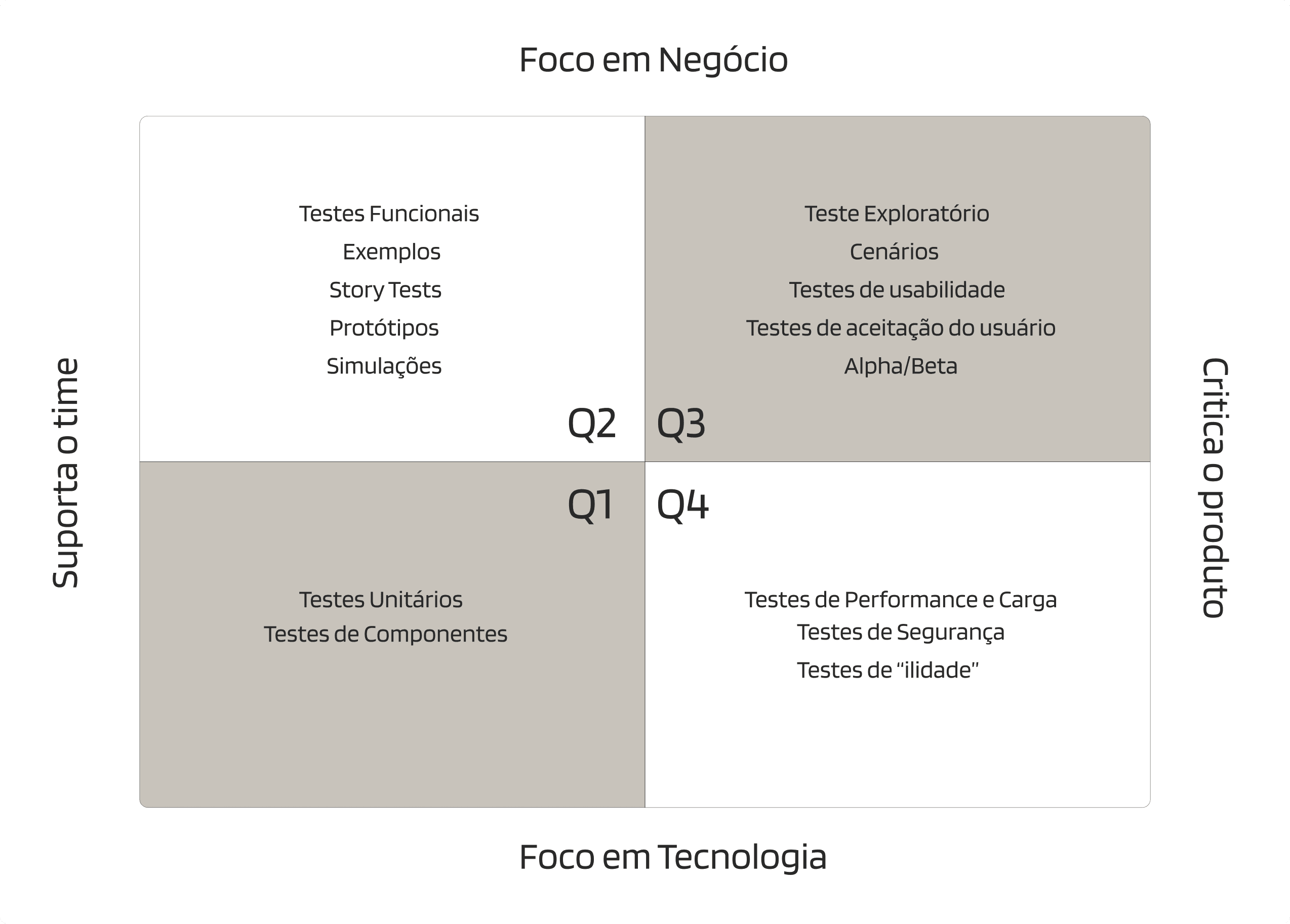
Software testing quadrants
Software testing quadrants help organize the different types of tests according to their purpose within development. Each quadrant represents a combination of business or technology focus and of tests that either support development or critically evaluate the product.
In this way, this model makes it easier to understand how tests are distributed throughout the development process.
Below, see how each quadrant works.
Q1. Tests focused on technology that support development
The first quadrant brings together software tests that directly support the development team's work. In this case, they have a technical focus and are usually automated, being run frequently during the coding process.
Thus, the goal of these tests is to ensure that individual parts of the system work correctly before moving on to more complex stages.
Among the main tests in this quadrant are:
Unit tests, which verify small isolated parts of the code, such as functions or methods, ensuring that each element of the system works independently.
In addition, component tests validate whether specific parts of the system work correctly and whether they integrate properly with other parts of the application.
Q2. Tests focused on business that support development
The second quadrant contains software tests aimed at validating business requirements. They also help the team during development, but their main focus is on the system's features and rules.
These tests can be automated or run manually, depending on the scenario.
Among the most common examples are:
Functional tests, which verify whether the system's features meet the defined requirements and business rules.
Story- or example-based tests, used to validate whether user stories and acceptance criteria were implemented correctly.
Prototypes and simulations, which make it possible to validate new features or flows before their full implementation, helping reduce development risks.
The third quadrant brings together software tests that critically analyze the product from the user's and business's perspective. In general, these tests tend to be more exploratory and are often run manually.
In this context, the goal is to identify problems that do not appear in automated or structured tests.
The tests in this quadrant include:
Exploratory tests, in which QA professionals investigate the system dynamically to identify unexpected failures.
In addition, usability tests assess whether the interface and flows are intuitive and easy to use.
User acceptance tests (UAT) check whether the product meets the expectations of end users or stakeholders.
Finally, Alpha and Beta tests are carried out with specific groups of users to identify improvements and possible issues before the official release.
Q3. Tests focused on business that evaluate the product
In the third quadrant are software tests aimed at the critical analysis of the product from the business and user perspective. These tests help identify problems that can impact the user experience or the value delivered by the system.
In general, they are more exploratory tests and are often carried out manually.
Among the most common examples are:
Exploratory tests, which allow the system to be investigated dynamically to uncover unexpected problems.
Usability tests, which evaluate the user experience and the ease of interacting with the product.
User acceptance tests (UAT), which verify whether the product meets the expectations and needs of end users.
Alpha and Beta tests, carried out with selected groups of users to identify possible issues before the official release.
Q4. Tests focused on technology that evaluate the product
In the fourth quadrant are software tests focused on technical evaluation of the system, with emphasis on aspects such as performance, security, and stability.
These tests usually use specific tools and help ensure the system works well under real usage conditions.
Among the most common examples are:
Performance and load tests, which analyze how the system behaves when it receives a large volume of accesses or requests.
Security tests, which check vulnerabilities and possible flaws in data protection and system access.
Technical quality tests, also called "ility" tests, which assess criteria such as reliability, scalability, and software stability.
What does a software tester do?
The software tester is the professional responsible for evaluating the quality of a system before it is made available to end users. In general, their main goal is to identify flaws, inconsistencies, and unexpected behaviors that could compromise how the application works.
To do this, the tester analyzes different aspects of the product, such as features, integrations between modules, performance, and usability. When they find problems, they record and document the defects so that the development team can fix them.
In addition, besides running software tests, this professional also participates in defining test scenarios, creating test cases, and validating the fixes made by the technical team.
In many projects, this role is associated with the Quality Analyst (QA), who works on planning the testing strategy and defining the system's acceptance criteria. However, responsibility for product quality should not rest with just one person.
In the agile development context, it is common for QA to work in collaboration with other areas, such as the Product Owner (PO) and the developers. In this way, these professionals help define the expected behaviors of the application and the minimum criteria to validate each feature.
Thus, this collaboration allows the developers themselves to run tests during code development, reducing the time between development and validation cycles and increasing process efficiency.
What are the 7 principles of software testing?
The 7 principles of software testing are widely used guidelines for steering quality strategies during development. They help teams understand the limitations of testing and apply practices more efficiently.
These principles were defined by ISTQB (International Software Testing Qualifications Board) and serve as a basis for structuring more effective software testing processes.
1. Tests show the presence of defects, not their absence
Software tests can reveal existing flaws in the system, but they cannot prove that the software is completely free of errors. Even after many tests, there is always the possibility of undetected defects.
2. Exhaustive testing is impossible
Testing every possible combination of inputs, scenarios, and conditions would be impractical. For this reason, software tests need to prioritize the most critical scenarios and the areas with the highest risk.
3. Testing early saves time and cost
The earlier a problem is identified in development, the easier and cheaper it is to fix. For this reason, software tests should begin from the early stages of the project.
4. Defects tend to cluster
A large share of defects is usually concentrated in a few areas of the system. This phenomenon is known as defect clustering and helps teams prioritize parts of the software that require more attention.
5. Pesticide paradox
Running the same software tests all the time tends to reduce their effectiveness over time. Just as a pesticide can lose its effect, tests need to be updated and diversified to keep finding new problems.
6. Testing depends on context
There is no single approach that works for all systems. The software testing strategy should consider factors such as the type of application, the level of risk, business requirements, and the product audience.
7. The absence of errors is a fallacy
A software product may have no technical defects and still fail to meet the needs of the user or the business. For this reason, software tests must also consider usability, requirements, and user expectations.
What are the 3 types of software testing?
In general, software tests can be classified into three main types, according to the level at which the system is analyzed during development. Each of these tests has a specific role in ensuring product quality.
Unit testing
Unit testing evaluates small parts of the code in isolation, such as functions, methods, or classes. This type of test is generally performed by the developers themselves during coding and is usually automated.
The goal is to ensure that each unit of the system works correctly before being integrated with other parts of the application.
Integration testing
Integration testing checks whether different modules or components of the software work correctly when connected. Even if each part works individually, problems can arise when they need to communicate with each other.
This type of test helps identify failures in data exchange or in the interaction between different parts of the system.
System testing
System testing evaluates the software as a whole, simulating the full operation of the application. At this point, the goal is to verify whether all features work together correctly and whether the system meets the defined requirements.
This type of test makes it possible to validate the application's behavior in a scenario closer to real use.
Examples of software testing
Software tests can be applied to different parts of a system to ensure that it works correctly, meets business requirements, and offers a good experience for users.
Below are some practical examples of software tests that are usually carried out during application development.
Login test
A common example of software testing is validating the authentication system. In this case, the goal is to check whether login works correctly when the user enters valid credentials and whether the system blocks access when the information is incorrect.
It is also possible to test access attempt limits or password recovery.
Form test
Another example is form testing, which checks whether required fields are being filled out correctly, whether the data is stored in the system, and whether validations are working as expected.
This type of test helps prevent errors in the submission or processing of information.
Calculation test
Systems that perform calculations, such as financial platforms or e-commerce sites, need specific tests to validate whether values are being processed correctly.
An example of software testing in this case is checking whether discounts, taxes, or fees are being applied correctly.
Performance test
Performance tests analyze how the system behaves under different usage conditions. One example is simulating hundreds or thousands of simultaneous accesses to verify whether the application continues to work without outages or slowdowns.
This type of test is essential for platforms that expect a high volume of users.
Usability test
Another important example is usability testing, which evaluates the user's experience while navigating the system. They analyze whether the interface is intuitive, whether the flows are clear, and whether tasks can be completed easily.
These tests help identify areas for improvement in how the product is interacted with.
Security test
Security tests check whether the system is protected against vulnerabilities and unauthorized access. One example is testing whether sensitive data is protected or whether there are flaws that allow attacks on the system.
This type of test is essential for applications that handle personal or financial data.
These examples show how software tests are applied in practice to ensure quality, stability, and security in digital products.
What are the software testing tools?
Software testing tools are used to support the process of verifying and validating systems during development. They help automate tests, analyze performance, identify failures, and organize the results of executions.
As a result, using these tools increases the team's efficiency, reduces manual errors, and expands the coverage of software tests.
Among the most widely used software testing tools on the market are:
Selenium
Selenium is one of the best-known tools for automating software tests in web applications. It allows the simulation of user interactions with the system, such as clicks, form filling, and navigation between pages.
For this reason, it is widely used for automated interface testing.
Cypress
Cypress is a modern tool focused on software tests in web applications. It allows tests to be written and run directly in the browser, offering a clear view of the system behavior during test execution.
In addition, it is widely used in projects that adopt agile development and continuous integration.
JUnit
JUnit is a popular tool for unit tests in applications developed in Java. It allows developers to create automated tests to validate small parts of the code, ensuring that each component works correctly.
TestNG
TestNG is another tool used mainly in Java projects. In this sense, it offers advanced features for organizing and running automated tests, allowing greater control over test scenarios.
JMeter
Apache JMeter is used for performance and load testing. With it, it is possible to simulate multiple simultaneous accesses to the system, helping evaluate how the application behaves under different levels of use.
Postman
Postman is widely used for testing APIs. Through this tool, it is possible to send requests to services, validate responses, and check whether integrations between systems are working correctly.
TestRail
TestRail is a software test management tool. Thus, it helps teams organize test cases, track executions, and record results, making quality process control easier.
In general, these tools are among the most used in the market and support different stages of software testing, from unit and functional tests to performance and integration tests. Therefore, the choice of the ideal tool depends on the type of application, the language used in the project, and the quality strategy adopted by the team.
Software testing as part of product quality
Digital projects require more than development. They need structure, quality, and well-defined processes. UEEK supports companies in creating and evolving digital products with specialized teams and a focus on results.
If your company is developing or evolving a digital product and is looking for more quality, stability, and security, get in touch and discover how we can help.
- let's talk
ALL CASES
Software testing: what it is, types, phases, and how it works in practice
•
15 min
Software testing is an essential stage in the development of digital systems. It ensures that an application works correctly, meets the defined requirements, and is ready for use with security and stability. Companies that neglect software testing face rework, increased costs, production failures, and loss of credibility.
Why are software tests important?
Software tests are important because they ensure quality, reduce risks, and protect the business against failures that can cause financial losses and damage credibility.
In addition, without software tests, the system may even work technically. However, without an adequate software testing strategy, that does not mean it will function safely, stably, or at scale.
What are the main software tests?
Software tests are organized into different categories to ensure that a system works correctly, is secure, performs well, and meets business expectations.
In addition, each type of software test covers a specific risk within the application. When different software tests are combined, they significantly increase the quality, stability, and predictability of the product.
In this way, the main software tests are organized according to the type of risk they need to mitigate within the system.
Functional testing
Functional software tests validate whether each feature fulfills what was defined in the system requirements. They answer the question: Does the application do exactly what it should do?
Example: validating whether a form saves data correctly or whether the calculation of a monthly fee is accurate.
Regression testing
Regression software tests ensure that new updates to the system do not break existing functionality. Whenever an improvement or fix is implemented, regression software tests confirm that the rest of the application continues to work stably.
For this reason, this type of software test is especially important in SaaS products, which often have frequent updates and releases.
Integration testing
Integration software tests check whether different modules work well when connected. Even if each part works in isolation, failures can arise in the communication between them. This test identifies this type of problem.
Load testing
Load software tests simulate multiple users accessing the system simultaneously. They help us understand how the application behaves during peak times.
Performance testing
Performance software tests analyze speed, response time, and stability under different conditions. The focus here is not only on supporting many accesses, but also on ensuring the system responds quickly and without freezes. They are essential for platforms that expect growth or high-traffic campaigns.
Usability testing
Usability software tests evaluate the user experience. They analyze whether navigation is intuitive, whether information is clear, and whether the system is easy to use. A software product may be technically correct but fail in the experience. This test prevents that risk.
Security testing
Security software tests identify vulnerabilities, authentication flaws, and data exposure risks. They are indispensable for systems that deal with sensitive information, payments, or personal data. Acceptance software tests validate whether the system meets the criteria defined by the business or the client.
They usually take place in the final phase of the project and confirm whether the product is ready for delivery.
What types of tests are there?
There are different types of software tests. A widely used way to organize them in an agile context, for example, is the test quadrants model.
In this model, the tests are structured around two main axes. On the horizontal axis, they are divided between those focused on the business and those focused on technology. On the vertical axis, the separation is between tests that support product development and tests that evaluate or challenge the system behavior.
In this way, this matrix helps teams better understand the role of each type of test within the development process and ensure a more balanced quality coverage.
Software testing quadrants
Software testing quadrants help organize the different types of tests according to their purpose within development. Each quadrant represents a combination of business or technology focus and of tests that either support development or critically evaluate the product.
In this way, this model makes it easier to understand how tests are distributed throughout the development process.
Below, see how each quadrant works.
Q1. Tests focused on technology that support development
The first quadrant brings together software tests that directly support the development team's work. In this case, they have a technical focus and are usually automated, being run frequently during the coding process.
Thus, the goal of these tests is to ensure that individual parts of the system work correctly before moving on to more complex stages.
Among the main tests in this quadrant are:
Unit tests, which verify small isolated parts of the code, such as functions or methods, ensuring that each element of the system works independently.
In addition, component tests validate whether specific parts of the system work correctly and whether they integrate properly with other parts of the application.
Q2. Tests focused on business that support development
The second quadrant contains software tests aimed at validating business requirements. They also help the team during development, but their main focus is on the system's features and rules.
These tests can be automated or run manually, depending on the scenario.
Among the most common examples are:
Functional tests, which verify whether the system's features meet the defined requirements and business rules.
Story- or example-based tests, used to validate whether user stories and acceptance criteria were implemented correctly.
Prototypes and simulations, which make it possible to validate new features or flows before their full implementation, helping reduce development risks.
The third quadrant brings together software tests that critically analyze the product from the user's and business's perspective. In general, these tests tend to be more exploratory and are often run manually.
In this context, the goal is to identify problems that do not appear in automated or structured tests.
The tests in this quadrant include:
Exploratory tests, in which QA professionals investigate the system dynamically to identify unexpected failures.
In addition, usability tests assess whether the interface and flows are intuitive and easy to use.
User acceptance tests (UAT) check whether the product meets the expectations of end users or stakeholders.
Finally, Alpha and Beta tests are carried out with specific groups of users to identify improvements and possible issues before the official release.
Q3. Tests focused on business that evaluate the product
In the third quadrant are software tests aimed at the critical analysis of the product from the business and user perspective. These tests help identify problems that can impact the user experience or the value delivered by the system.
In general, they are more exploratory tests and are often carried out manually.
Among the most common examples are:
Exploratory tests, which allow the system to be investigated dynamically to uncover unexpected problems.
Usability tests, which evaluate the user experience and the ease of interacting with the product.
User acceptance tests (UAT), which verify whether the product meets the expectations and needs of end users.
Alpha and Beta tests, carried out with selected groups of users to identify possible issues before the official release.
Q4. Tests focused on technology that evaluate the product
In the fourth quadrant are software tests focused on technical evaluation of the system, with emphasis on aspects such as performance, security, and stability.
These tests usually use specific tools and help ensure the system works well under real usage conditions.
Among the most common examples are:
Performance and load tests, which analyze how the system behaves when it receives a large volume of accesses or requests.
Security tests, which check vulnerabilities and possible flaws in data protection and system access.
Technical quality tests, also called "ility" tests, which assess criteria such as reliability, scalability, and software stability.
What does a software tester do?
The software tester is the professional responsible for evaluating the quality of a system before it is made available to end users. In general, their main goal is to identify flaws, inconsistencies, and unexpected behaviors that could compromise how the application works.
To do this, the tester analyzes different aspects of the product, such as features, integrations between modules, performance, and usability. When they find problems, they record and document the defects so that the development team can fix them.
In addition, besides running software tests, this professional also participates in defining test scenarios, creating test cases, and validating the fixes made by the technical team.
In many projects, this role is associated with the Quality Analyst (QA), who works on planning the testing strategy and defining the system's acceptance criteria. However, responsibility for product quality should not rest with just one person.
In the agile development context, it is common for QA to work in collaboration with other areas, such as the Product Owner (PO) and the developers. In this way, these professionals help define the expected behaviors of the application and the minimum criteria to validate each feature.
Thus, this collaboration allows the developers themselves to run tests during code development, reducing the time between development and validation cycles and increasing process efficiency.
What are the 7 principles of software testing?
The 7 principles of software testing are widely used guidelines for steering quality strategies during development. They help teams understand the limitations of testing and apply practices more efficiently.
These principles were defined by ISTQB (International Software Testing Qualifications Board) and serve as a basis for structuring more effective software testing processes.
1. Tests show the presence of defects, not their absence
Software tests can reveal existing flaws in the system, but they cannot prove that the software is completely free of errors. Even after many tests, there is always the possibility of undetected defects.
2. Exhaustive testing is impossible
Testing every possible combination of inputs, scenarios, and conditions would be impractical. For this reason, software tests need to prioritize the most critical scenarios and the areas with the highest risk.
3. Testing early saves time and cost
The earlier a problem is identified in development, the easier and cheaper it is to fix. For this reason, software tests should begin from the early stages of the project.
4. Defects tend to cluster
A large share of defects is usually concentrated in a few areas of the system. This phenomenon is known as defect clustering and helps teams prioritize parts of the software that require more attention.
5. Pesticide paradox
Running the same software tests all the time tends to reduce their effectiveness over time. Just as a pesticide can lose its effect, tests need to be updated and diversified to keep finding new problems.
6. Testing depends on context
There is no single approach that works for all systems. The software testing strategy should consider factors such as the type of application, the level of risk, business requirements, and the product audience.
7. The absence of errors is a fallacy
A software product may have no technical defects and still fail to meet the needs of the user or the business. For this reason, software tests must also consider usability, requirements, and user expectations.
What are the 3 types of software testing?
In general, software tests can be classified into three main types, according to the level at which the system is analyzed during development. Each of these tests has a specific role in ensuring product quality.
Unit testing
Unit testing evaluates small parts of the code in isolation, such as functions, methods, or classes. This type of test is generally performed by the developers themselves during coding and is usually automated.
The goal is to ensure that each unit of the system works correctly before being integrated with other parts of the application.
Integration testing
Integration testing checks whether different modules or components of the software work correctly when connected. Even if each part works individually, problems can arise when they need to communicate with each other.
This type of test helps identify failures in data exchange or in the interaction between different parts of the system.
System testing
System testing evaluates the software as a whole, simulating the full operation of the application. At this point, the goal is to verify whether all features work together correctly and whether the system meets the defined requirements.
This type of test makes it possible to validate the application's behavior in a scenario closer to real use.
Examples of software testing
Software tests can be applied to different parts of a system to ensure that it works correctly, meets business requirements, and offers a good experience for users.
Below are some practical examples of software tests that are usually carried out during application development.
Login test
A common example of software testing is validating the authentication system. In this case, the goal is to check whether login works correctly when the user enters valid credentials and whether the system blocks access when the information is incorrect.
It is also possible to test access attempt limits or password recovery.
Form test
Another example is form testing, which checks whether required fields are being filled out correctly, whether the data is stored in the system, and whether validations are working as expected.
This type of test helps prevent errors in the submission or processing of information.
Calculation test
Systems that perform calculations, such as financial platforms or e-commerce sites, need specific tests to validate whether values are being processed correctly.
An example of software testing in this case is checking whether discounts, taxes, or fees are being applied correctly.
Performance test
Performance tests analyze how the system behaves under different usage conditions. One example is simulating hundreds or thousands of simultaneous accesses to verify whether the application continues to work without outages or slowdowns.
This type of test is essential for platforms that expect a high volume of users.
Usability test
Another important example is usability testing, which evaluates the user's experience while navigating the system. They analyze whether the interface is intuitive, whether the flows are clear, and whether tasks can be completed easily.
These tests help identify areas for improvement in how the product is interacted with.
Security test
Security tests check whether the system is protected against vulnerabilities and unauthorized access. One example is testing whether sensitive data is protected or whether there are flaws that allow attacks on the system.
This type of test is essential for applications that handle personal or financial data.
These examples show how software tests are applied in practice to ensure quality, stability, and security in digital products.
What are the software testing tools?
Software testing tools are used to support the process of verifying and validating systems during development. They help automate tests, analyze performance, identify failures, and organize the results of executions.
As a result, using these tools increases the team's efficiency, reduces manual errors, and expands the coverage of software tests.
Among the most widely used software testing tools on the market are:
Selenium
Selenium is one of the best-known tools for automating software tests in web applications. It allows the simulation of user interactions with the system, such as clicks, form filling, and navigation between pages.
For this reason, it is widely used for automated interface testing.
Cypress
Cypress is a modern tool focused on software tests in web applications. It allows tests to be written and run directly in the browser, offering a clear view of the system behavior during test execution.
In addition, it is widely used in projects that adopt agile development and continuous integration.
JUnit
JUnit is a popular tool for unit tests in applications developed in Java. It allows developers to create automated tests to validate small parts of the code, ensuring that each component works correctly.
TestNG
TestNG is another tool used mainly in Java projects. In this sense, it offers advanced features for organizing and running automated tests, allowing greater control over test scenarios.
JMeter
Apache JMeter is used for performance and load testing. With it, it is possible to simulate multiple simultaneous accesses to the system, helping evaluate how the application behaves under different levels of use.
Postman
Postman is widely used for testing APIs. Through this tool, it is possible to send requests to services, validate responses, and check whether integrations between systems are working correctly.
TestRail
TestRail is a software test management tool. Thus, it helps teams organize test cases, track executions, and record results, making quality process control easier.
In general, these tools are among the most used in the market and support different stages of software testing, from unit and functional tests to performance and integration tests. Therefore, the choice of the ideal tool depends on the type of application, the language used in the project, and the quality strategy adopted by the team.
Software testing as part of product quality
Digital projects require more than development. They need structure, quality, and well-defined processes. UEEK supports companies in creating and evolving digital products with specialized teams and a focus on results.
If your company is developing or evolving a digital product and is looking for more quality, stability, and security, get in touch and discover how we can help.
- let's talk
ALL CASES
Software testing: what it is, types, phases, and how it works in practice
•
15 min
Software testing is an essential stage in the development of digital systems. It ensures that an application works correctly, meets the defined requirements, and is ready for use with security and stability. Companies that neglect software testing face rework, increased costs, production failures, and loss of credibility.
Why are software tests important?
Software tests are important because they ensure quality, reduce risks, and protect the business against failures that can cause financial losses and damage credibility.
In addition, without software tests, the system may even work technically. However, without an adequate software testing strategy, that does not mean it will function safely, stably, or at scale.
What are the main software tests?
Software tests are organized into different categories to ensure that a system works correctly, is secure, performs well, and meets business expectations.
In addition, each type of software test covers a specific risk within the application. When different software tests are combined, they significantly increase the quality, stability, and predictability of the product.
In this way, the main software tests are organized according to the type of risk they need to mitigate within the system.
Functional testing
Functional software tests validate whether each feature fulfills what was defined in the system requirements. They answer the question: Does the application do exactly what it should do?
Example: validating whether a form saves data correctly or whether the calculation of a monthly fee is accurate.
Regression testing
Regression software tests ensure that new updates to the system do not break existing functionality. Whenever an improvement or fix is implemented, regression software tests confirm that the rest of the application continues to work stably.
For this reason, this type of software test is especially important in SaaS products, which often have frequent updates and releases.
Integration testing
Integration software tests check whether different modules work well when connected. Even if each part works in isolation, failures can arise in the communication between them. This test identifies this type of problem.
Load testing
Load software tests simulate multiple users accessing the system simultaneously. They help us understand how the application behaves during peak times.
Performance testing
Performance software tests analyze speed, response time, and stability under different conditions. The focus here is not only on supporting many accesses, but also on ensuring the system responds quickly and without freezes. They are essential for platforms that expect growth or high-traffic campaigns.
Usability testing
Usability software tests evaluate the user experience. They analyze whether navigation is intuitive, whether information is clear, and whether the system is easy to use. A software product may be technically correct but fail in the experience. This test prevents that risk.
Security testing
Security software tests identify vulnerabilities, authentication flaws, and data exposure risks. They are indispensable for systems that deal with sensitive information, payments, or personal data. Acceptance software tests validate whether the system meets the criteria defined by the business or the client.
They usually take place in the final phase of the project and confirm whether the product is ready for delivery.
What types of tests are there?
There are different types of software tests. A widely used way to organize them in an agile context, for example, is the test quadrants model.
In this model, the tests are structured around two main axes. On the horizontal axis, they are divided between those focused on the business and those focused on technology. On the vertical axis, the separation is between tests that support product development and tests that evaluate or challenge the system behavior.
In this way, this matrix helps teams better understand the role of each type of test within the development process and ensure a more balanced quality coverage.
Software testing quadrants
Software testing quadrants help organize the different types of tests according to their purpose within development. Each quadrant represents a combination of business or technology focus and of tests that either support development or critically evaluate the product.
In this way, this model makes it easier to understand how tests are distributed throughout the development process.
Below, see how each quadrant works.
Q1. Tests focused on technology that support development
The first quadrant brings together software tests that directly support the development team's work. In this case, they have a technical focus and are usually automated, being run frequently during the coding process.
Thus, the goal of these tests is to ensure that individual parts of the system work correctly before moving on to more complex stages.
Among the main tests in this quadrant are:
Unit tests, which verify small isolated parts of the code, such as functions or methods, ensuring that each element of the system works independently.
In addition, component tests validate whether specific parts of the system work correctly and whether they integrate properly with other parts of the application.
Q2. Tests focused on business that support development
The second quadrant contains software tests aimed at validating business requirements. They also help the team during development, but their main focus is on the system's features and rules.
These tests can be automated or run manually, depending on the scenario.
Among the most common examples are:
Functional tests, which verify whether the system's features meet the defined requirements and business rules.
Story- or example-based tests, used to validate whether user stories and acceptance criteria were implemented correctly.
Prototypes and simulations, which make it possible to validate new features or flows before their full implementation, helping reduce development risks.
The third quadrant brings together software tests that critically analyze the product from the user's and business's perspective. In general, these tests tend to be more exploratory and are often run manually.
In this context, the goal is to identify problems that do not appear in automated or structured tests.
The tests in this quadrant include:
Exploratory tests, in which QA professionals investigate the system dynamically to identify unexpected failures.
In addition, usability tests assess whether the interface and flows are intuitive and easy to use.
User acceptance tests (UAT) check whether the product meets the expectations of end users or stakeholders.
Finally, Alpha and Beta tests are carried out with specific groups of users to identify improvements and possible issues before the official release.
Q3. Tests focused on business that evaluate the product
In the third quadrant are software tests aimed at the critical analysis of the product from the business and user perspective. These tests help identify problems that can impact the user experience or the value delivered by the system.
In general, they are more exploratory tests and are often carried out manually.
Among the most common examples are:
Exploratory tests, which allow the system to be investigated dynamically to uncover unexpected problems.
Usability tests, which evaluate the user experience and the ease of interacting with the product.
User acceptance tests (UAT), which verify whether the product meets the expectations and needs of end users.
Alpha and Beta tests, carried out with selected groups of users to identify possible issues before the official release.
Q4. Tests focused on technology that evaluate the product
In the fourth quadrant are software tests focused on technical evaluation of the system, with emphasis on aspects such as performance, security, and stability.
These tests usually use specific tools and help ensure the system works well under real usage conditions.
Among the most common examples are:
Performance and load tests, which analyze how the system behaves when it receives a large volume of accesses or requests.
Security tests, which check vulnerabilities and possible flaws in data protection and system access.
Technical quality tests, also called "ility" tests, which assess criteria such as reliability, scalability, and software stability.
What does a software tester do?
The software tester is the professional responsible for evaluating the quality of a system before it is made available to end users. In general, their main goal is to identify flaws, inconsistencies, and unexpected behaviors that could compromise how the application works.
To do this, the tester analyzes different aspects of the product, such as features, integrations between modules, performance, and usability. When they find problems, they record and document the defects so that the development team can fix them.
In addition, besides running software tests, this professional also participates in defining test scenarios, creating test cases, and validating the fixes made by the technical team.
In many projects, this role is associated with the Quality Analyst (QA), who works on planning the testing strategy and defining the system's acceptance criteria. However, responsibility for product quality should not rest with just one person.
In the agile development context, it is common for QA to work in collaboration with other areas, such as the Product Owner (PO) and the developers. In this way, these professionals help define the expected behaviors of the application and the minimum criteria to validate each feature.
Thus, this collaboration allows the developers themselves to run tests during code development, reducing the time between development and validation cycles and increasing process efficiency.
What are the 7 principles of software testing?
The 7 principles of software testing are widely used guidelines for steering quality strategies during development. They help teams understand the limitations of testing and apply practices more efficiently.
These principles were defined by ISTQB (International Software Testing Qualifications Board) and serve as a basis for structuring more effective software testing processes.
1. Tests show the presence of defects, not their absence
Software tests can reveal existing flaws in the system, but they cannot prove that the software is completely free of errors. Even after many tests, there is always the possibility of undetected defects.
2. Exhaustive testing is impossible
Testing every possible combination of inputs, scenarios, and conditions would be impractical. For this reason, software tests need to prioritize the most critical scenarios and the areas with the highest risk.
3. Testing early saves time and cost
The earlier a problem is identified in development, the easier and cheaper it is to fix. For this reason, software tests should begin from the early stages of the project.
4. Defects tend to cluster
A large share of defects is usually concentrated in a few areas of the system. This phenomenon is known as defect clustering and helps teams prioritize parts of the software that require more attention.
5. Pesticide paradox
Running the same software tests all the time tends to reduce their effectiveness over time. Just as a pesticide can lose its effect, tests need to be updated and diversified to keep finding new problems.
6. Testing depends on context
There is no single approach that works for all systems. The software testing strategy should consider factors such as the type of application, the level of risk, business requirements, and the product audience.
7. The absence of errors is a fallacy
A software product may have no technical defects and still fail to meet the needs of the user or the business. For this reason, software tests must also consider usability, requirements, and user expectations.
What are the 3 types of software testing?
In general, software tests can be classified into three main types, according to the level at which the system is analyzed during development. Each of these tests has a specific role in ensuring product quality.
Unit testing
Unit testing evaluates small parts of the code in isolation, such as functions, methods, or classes. This type of test is generally performed by the developers themselves during coding and is usually automated.
The goal is to ensure that each unit of the system works correctly before being integrated with other parts of the application.
Integration testing
Integration testing checks whether different modules or components of the software work correctly when connected. Even if each part works individually, problems can arise when they need to communicate with each other.
This type of test helps identify failures in data exchange or in the interaction between different parts of the system.
System testing
System testing evaluates the software as a whole, simulating the full operation of the application. At this point, the goal is to verify whether all features work together correctly and whether the system meets the defined requirements.
This type of test makes it possible to validate the application's behavior in a scenario closer to real use.
Examples of software testing
Software tests can be applied to different parts of a system to ensure that it works correctly, meets business requirements, and offers a good experience for users.
Below are some practical examples of software tests that are usually carried out during application development.
Login test
A common example of software testing is validating the authentication system. In this case, the goal is to check whether login works correctly when the user enters valid credentials and whether the system blocks access when the information is incorrect.
It is also possible to test access attempt limits or password recovery.
Form test
Another example is form testing, which checks whether required fields are being filled out correctly, whether the data is stored in the system, and whether validations are working as expected.
This type of test helps prevent errors in the submission or processing of information.
Calculation test
Systems that perform calculations, such as financial platforms or e-commerce sites, need specific tests to validate whether values are being processed correctly.
An example of software testing in this case is checking whether discounts, taxes, or fees are being applied correctly.
Performance test
Performance tests analyze how the system behaves under different usage conditions. One example is simulating hundreds or thousands of simultaneous accesses to verify whether the application continues to work without outages or slowdowns.
This type of test is essential for platforms that expect a high volume of users.
Usability test
Another important example is usability testing, which evaluates the user's experience while navigating the system. They analyze whether the interface is intuitive, whether the flows are clear, and whether tasks can be completed easily.
These tests help identify areas for improvement in how the product is interacted with.
Security test
Security tests check whether the system is protected against vulnerabilities and unauthorized access. One example is testing whether sensitive data is protected or whether there are flaws that allow attacks on the system.
This type of test is essential for applications that handle personal or financial data.
These examples show how software tests are applied in practice to ensure quality, stability, and security in digital products.
What are the software testing tools?
Software testing tools are used to support the process of verifying and validating systems during development. They help automate tests, analyze performance, identify failures, and organize the results of executions.
As a result, using these tools increases the team's efficiency, reduces manual errors, and expands the coverage of software tests.
Among the most widely used software testing tools on the market are:
Selenium
Selenium is one of the best-known tools for automating software tests in web applications. It allows the simulation of user interactions with the system, such as clicks, form filling, and navigation between pages.
For this reason, it is widely used for automated interface testing.
Cypress
Cypress is a modern tool focused on software tests in web applications. It allows tests to be written and run directly in the browser, offering a clear view of the system behavior during test execution.
In addition, it is widely used in projects that adopt agile development and continuous integration.
JUnit
JUnit is a popular tool for unit tests in applications developed in Java. It allows developers to create automated tests to validate small parts of the code, ensuring that each component works correctly.
TestNG
TestNG is another tool used mainly in Java projects. In this sense, it offers advanced features for organizing and running automated tests, allowing greater control over test scenarios.
JMeter
Apache JMeter is used for performance and load testing. With it, it is possible to simulate multiple simultaneous accesses to the system, helping evaluate how the application behaves under different levels of use.
Postman
Postman is widely used for testing APIs. Through this tool, it is possible to send requests to services, validate responses, and check whether integrations between systems are working correctly.
TestRail
TestRail is a software test management tool. Thus, it helps teams organize test cases, track executions, and record results, making quality process control easier.
In general, these tools are among the most used in the market and support different stages of software testing, from unit and functional tests to performance and integration tests. Therefore, the choice of the ideal tool depends on the type of application, the language used in the project, and the quality strategy adopted by the team.
Software testing as part of product quality
Digital projects require more than development. They need structure, quality, and well-defined processes. UEEK supports companies in creating and evolving digital products with specialized teams and a focus on results.
If your company is developing or evolving a digital product and is looking for more quality, stability, and security, get in touch and discover how we can help.
- let's talk